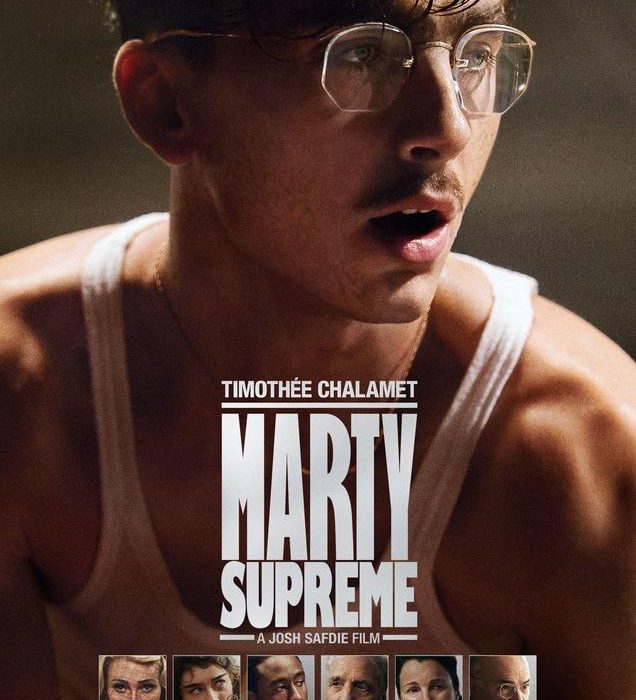
Marty Supreme (2025): Cast, Plot, Release Date, and What Makes Josh Safdie’s Ping-Pong Fever Dream So Addictive
Josh Safdie’s Marty Supreme (2025) takes the “sports movie” template, spins it on a fingertip like a trick serve, and then fires it straight into a hustler’s moral abyss. Led by Timothée Chalamet as a self-mythologizing table-tennis obsessive, the film is set in early-1950s New York and runs on the same propulsive, high-velocity energy that’s become Safdie’s signature—only here it’s filtered through screwball comedy, period textures, and a manic need for fame.
The result is a film that’s less about winning a match than it is about selling a persona—sometimes literally. Marty Supreme follows a young man who wants the world to watch him play, worship him, buy into him… and forgive whatever he does to get there.
Marty Supreme at a Glance
| Detail | Info |
|---|---|
| Title | Marty Supreme |
| Year | 2025 |
| Director | Josh Safdie |
| Writers | Josh Safdie, Ronald Bronstein |
| Distributor | A24 |
| Runtime | 150 minutes (2h 30m / 2h 29m listed) |
| Rating | R |
| Theatrical release (US) | December 25, 2025 (wide) |
| World premiere | New York Film Festival “secret screening” (Oct 6, 2025) |
| Loosely inspired by | Table tennis player Marty Reisman |
Cast and Characters
Safdie surrounds Chalamet with a lineup that reads like a provocation—part prestige, part stunt-casting, part downtown texture.
Main cast (as credited in major listings):
-
Timothée Chalamet as Marty Mauser
-
Gwyneth Paltrow
-
Odessa A’zion
-
Fran Drescher
-
Kevin O’Leary
-
Tyler Okonma (Tyler, the Creator)
-
Abel Ferrara
Behind the camera, Safdie teams with heavy hitters: Darius Khondji (cinematography) and Daniel Lopatin (music), with Ronald Bronstein again central to the film’s nervous-system editing and writing DNA.
Setting and Genre: Sports Comedy-Drama, Hustler Movie, Character Study
On paper, Marty Supreme is a sports comedy-drama: a gifted player tries to make it big. In practice, it behaves more like a hustler saga—a story about the American talent for reinvention, and the collateral damage left behind by anyone who treats life like a permanent pitch meeting.
It’s set in 1952 New York, but critics have noted Safdie’s deliberately “displaced” style choices—period world, modern nervous energy, and needle-drop anachronism used as a feature rather than a mistake.
Full Plot Synopsis (Spoilers Included)
Marty Mauser is a young New Yorker in 1952 who works as a shoe salesman by day while chasing a more intoxicating identity: table tennis star. He doesn’t just want to win—he wants to matter, to be talked about, to make the sport (and himself) unavoidable.
Marty’s dream is specific and grandiose: he wants to travel to London, compete at the British Open, and beat the reigning European champion. He’s also pushing a hustle-adjacent business idea—novelty orange ping-pong balls branded with his name, “Marty Supreme,” as if a logo alone can will him into legend.
The problem is money—and Marty’s total inability to accept “no.” When his uncle (who runs the shoe shop) refuses to fund the trip, Marty escalates. In a moment that clarifies exactly what kind of protagonist this is, he robs the shop’s vault at gunpoint, forcing a coworker to comply. It’s the movie’s thesis in miniature: Marty will take whatever he believes he’s destined to have, and call it ambition.
In London, Marty rejects the modest circumstances of the other players and installs himself in luxury at the Ritz, performing success before he’s earned it. There he becomes entangled with Kay Stone, a former actress, and crosses paths with her wealthy husband, Milton Rockwell, a powerful businessman whose influence (and menace) adds a new level of danger to Marty’s improvisational climb.
Marty’s raw competitiveness does get him far: he defeats the top European rival in the semifinals. But the story refuses the clean catharsis of a standard sports finale. In the championship match, Marty loses to Koto Endo, a deaf Japanese player whose equipment and style represent a future Marty can’t charm, bully, or out-market. The defeat lands not as a life lesson but as a bruise to Marty’s self-created mythology—proof that the world won’t always cooperate with his script.
What the Film Is Really About
1) The performance of greatness
Marty doesn’t just chase excellence—he chases recognition. The branded balls, the luxury hotel, the compulsive talk: it’s all part of a persona campaign. In that sense, Marty Supreme plays like a period piece about something very current: how identity becomes a product, and how easily “confidence” can curdle into entitlement.
2) A sports movie that moves like a ping-pong rally
Critics have described the film’s rhythm as intentionally match-like—fast, unpredictable, aggressive, and exhausting. It’s not aiming for inspirational uplift; it’s aiming for velocity, the feeling that Marty’s mind is a room you can’t exit because he keeps locking new doors behind you.
3) Hustling as a form of faith
Marty’s hustles aren’t side quests—they’re belief systems. Every scheme is his way of insisting reality should bend to his will. That’s why the film’s funniest moments often sit next to its ugliest ones: the laugh catches in your throat because you realize the joke and the tragedy are powered by the same motor.
Performances: Chalamet’s Controlled Chaos, Paltrow’s Sharp Counterweight
Timothée Chalamet has been widely praised for making Marty both magnetic and aggravating—an ego machine with enough vulnerability to keep you watching even when you want to yank the plug. Several reviews frame the performance as a major “step into adulthood” for the actor, because he’s willing to bury his natural likability under narcissism and compulsion.
Gwyneth Paltrow provides an essential tonal counterbalance. In a film built on Marty’s relentless self-belief, her presence introduces skepticism, appetite, and a kind of bruised clarity—someone who understands how fame works because she’s lived on the other side of it.
Direction, Cinematography, and Sound: Period Grit with Modern Nerves
Safdie’s direction is all about friction: comedy scraping against anxiety; glamour rubbing up against sweat. Visually, Darius Khondji shoots the film largely on 35mm with choices designed to bring the camera uncomfortably close—less “handsome period tableau,” more “you’re trapped in Marty’s orbit.”
Meanwhile, the music and soundtrack approach—highlighted by critics as intentionally disorienting—adds to that temporal vertigo: a 1950s story told with a restless, later-century pulse.
Strengths and Weaknesses
What works best
-
A genuinely specific protagonist: Marty isn’t a generic underdog; he’s a hustler who treats destiny like a debt the world owes him.
-
Propulsive, nerve-jangling momentum: even quiet scenes feel like they’re leaning forward.
-
Casting that adds texture: the supporting ensemble makes the world feel unpredictable, like anyone might hijack the scene (or the whole movie).
What may not work for everyone
-
Deliberate disorientation: the film’s stylistic “wrongness” is part of the point, but it can feel abrasive if you want clean period immersion.
-
An intentionally unpleasant hero: Marty’s charm is real, but so is the ego—and the movie doesn’t sand it down for comfort.
Why Marty Supreme Is a Google Discover-Friendly Conversation Starter
Part of Marty Supreme’s appeal is that it’s easy to describe in one breath (“Chalamet as a ping-pong hustler in a Safdie pressure-cooker”), but hard to pin down emotionally. It’s funny until it’s not, glamorous until it’s grimy, romantic until it’s transactional. That slipperiness makes it prime for debate: is Marty a visionary, a con artist, or a tragedy with good hair?
And in a landscape full of neatly branded “inspiring sports stories,” Marty Supreme stands out by refusing inspiration as an endpoint. It’s more interested in obsession: what it gives you, what it costs, and who gets stuck cleaning up the mess.
FAQ (SEO)
Is Marty Supreme based on a true story?
It’s loosely inspired by real-life American table tennis player Marty Reisman, but the film is presented as a fictionalized story centered on Marty Mauser.
When was Marty Supreme released?
It premiered as a NYFF secret screening on October 6, 2025, and opened wide in the U.S. on December 25, 2025 (with a limited run starting Dec 19).
How long is Marty Supreme?
Major listings place it at roughly 150 minutes (around 2h 29m–2h 30m).
Final Verdict
Marty Supreme is a sports movie the way a siren is a singer: it uses the shape of something familiar to lure you into stranger waters. Josh Safdie turns table tennis into a metaphor for attention—how it’s won, how it’s stolen, how it ricochets. Anchored by Chalamet’s volatile intensity and supported by a cast that keeps the film off-balance in the best way, it’s less a crowd-pleaser than a crowd-provoker—messy, high-wire, and hard to forget.