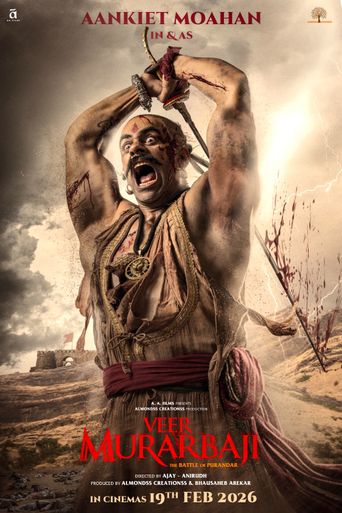
Veer Murarbaji: The Battle of Purandar (2026) – A Landmark Historical War Drama in Indian Cinema
Release Date: 19 February 2026
Genre: Historical, War, Drama
Language: Marathi and Hindi
Directors: Ajay Arekar & Anirudh Arekar
Lead Cast: Ankit Mohan, Sourabh Raaj Jain, Dipika Chikhlia, Arun Govil, Santosh Juvekar
Runtime: 2 hours 18 minutes
Veer Murarbaji: The Battle of Purandar (2026) is an ambitious Indian historical war drama that revisits one of the most significant military confrontations in Maratha history—the 1665 Siege of Purandar. Directed by Ajay and Anirudh Arekar, the film presents a dignified and cinematic retelling of the life and sacrifice of Murarbaji Deshpande, a trusted commander of Chhatrapati Shivaji Maharaj.
Positioned as both a tribute and a large-scale period epic, the film aims to combine historical authenticity with emotionally driven storytelling. Released in both Marathi and Hindi, it seeks to bring regional history to a national audience while preserving cultural specificity.
Historical Context: The Battle of Purandar
The Battle of Purandar took place in 1665 when Mughal forces, led by Mirza Raja Jai Singh I and Diler Khan, laid siege to the strategically crucial Purandar Fort. The Maratha Empire, under the leadership of Chhatrapati Shivaji Maharaj, faced overwhelming opposition.
Murarbaji Deshpande emerged as a central figure during the siege, commanding a small contingent of Maval warriors in a determined defense of the fort. His final charge against Mughal forces, despite certain defeat, became a defining moment in Maratha history—symbolizing loyalty, courage, and sacrifice.
The film uses this historical event as its narrative foundation, striving to depict not just military action but the ideological and emotional dimensions of Swarajya (self-rule).
Plot Overview
The narrative unfolds in three structured movements:
1. Political Tensions and Strategic Stakes
The opening act establishes the broader political climate of 17th-century India. Shivaji Maharaj (Sourabh Raaj Jain) is portrayed as a visionary leader consolidating Maratha sovereignty. The Mughal Empire’s expansionist campaign threatens to destabilize the region, setting the stage for confrontation.
Murarbaji Deshpande (Ankit Mohan) is introduced as a loyal and battle-ready commander, deeply committed to Shivaji’s vision.
2. The Siege of Purandar
The film transitions into the prolonged siege of Purandar Fort. Mughal artillery, numerical superiority, and strategic blockades place immense pressure on the Maratha defenders.
Inside the fort, morale fluctuates as resources diminish. Murarbaji organizes resistance efforts, reinforcing discipline and unity among his soldiers. The screenplay carefully balances war sequences with moments of reflection, emphasizing duty over despair.
3. The Final Stand
In the climactic act, Murarbaji leads a direct assault against Mughal forces, fully aware of the fatal consequences. His refusal to surrender becomes the emotional core of the film.
The narrative concludes with his martyrdom, presenting his sacrifice as a moral and symbolic victory that transcends military defeat.
Cast and Performances
Ankit Mohan as Murarbaji Deshpande
Ankit Mohan delivers a restrained yet commanding performance. His portrayal focuses on stoicism and resolve rather than theatrical heroics. The physical demands of the role are matched by measured emotional intensity, particularly in the final battle sequence.
Sourabh Raaj Jain as Chhatrapati Shivaji Maharaj
Sourabh Raaj Jain presents Shivaji Maharaj as composed and strategic, embodying leadership grounded in foresight and diplomacy. His interactions with Murarbaji add emotional gravity to the narrative.
Supporting Ensemble
Veteran performers such as Dipika Chikhlia and Arun Govil contribute gravitas, reinforcing the ideological stakes of the story. Santosh Juvekar enhances the intensity of battlefield scenes, while the Mughal commanders are depicted with formal authority, though with limited narrative exploration.
Direction and Screenplay
Ajay and Anirudh Arekar adopt a classical storytelling approach, emphasizing historical fidelity. The direction avoids sensationalism, opting instead for measured pacing and deliberate buildup.
The screenplay prioritizes clarity over complexity. While this approach ensures accessibility for broad audiences, it also results in limited psychological nuance. Murarbaji is portrayed as unwaveringly noble—a choice that reinforces reverence but reduces internal conflict.
Nevertheless, the film succeeds in maintaining thematic coherence and narrative focus.
Cinematography and Production Design
The visual language of Veer Murarbaji: The Battle of Purandar reflects meticulous attention to detail.
-
Fort Architecture: Purandar Fort is recreated with authenticity, emphasizing stone textures and expansive ramparts.
-
Costume Design: Period-accurate armor and attire reinforce historical immersion.
-
Battle Choreography: Combat sequences rely on practical staging, enhanced with restrained digital effects.
The cinematography employs wide-angle compositions to emphasize scale, while close-up shots capture emotional tension within confined spaces.
Music and Sound Design
The background score incorporates traditional Marathi musical motifs alongside orchestral war themes. Percussion-heavy compositions heighten battlefield tension.
Sound design plays a crucial role in enhancing realism—cannon fire, clashing steel, and echoing war cries create immersive intensity. The restrained use of silence in key moments strengthens emotional impact.
Core Themes
Courage Beyond Victory
The film emphasizes that heroism does not always culminate in triumph. Murarbaji’s legacy is defined not by success, but by steadfastness.
Loyalty and Leadership
The relationship between Murarbaji and Shivaji Maharaj underscores a leadership model built on mutual respect and ideological alignment.
Cultural Memory
By spotlighting a relatively underrepresented historical figure, the film contributes to preserving regional history within mainstream cinematic discourse.
Strengths and Limitations
Strengths
-
Strong and dignified lead performance
-
Authentic historical detailing
-
Well-executed siege sequences
-
Clear thematic focus
-
Cultural and educational value
Limitations
-
Predictable narrative progression
-
Limited development of antagonistic characters
-
Minimal exploration of internal conflict
Final Assessment
Veer Murarbaji: The Battle of Purandar stands as a respectful and visually engaging tribute to one of the Maratha Empire’s most revered warriors. While it adheres closely to historical accounts and avoids dramatic reinterpretation, its sincerity and production scale make it a noteworthy entry in Indian historical cinema.
The film will particularly resonate with audiences interested in Indian history, war dramas, and stories of sacrifice rooted in regional heritage.
Overall Rating: 3.5 out of 5