


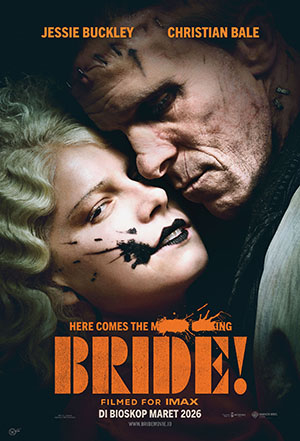
The Resurrection of a Legend: A Comprehensive Review of Maggie Gyllenhaal’s ‘The Bride!’
In the sprawling landscape of modern cinema, few figures are as enduring—or as frequently reinterpreted—as Mary Shelley’s creation. Yet, in The Bride! (2026), writer-director Maggie Gyllenhaal bypasses the traditional gothic tropes to deliver something far more combustible. Following her critically acclaimed directorial debut The Lost Daughter, Gyllenhaal returns with a vibrant, “punk-rock” reimagining of the 1935 James Whale classic, Bride of Frankenstein.
This is not a dusty period piece or a jump-scare-laden horror flick. Instead, The Bride! is a high-voltage blend of dark comedy, noir romance, and social critique, set against the grit of 1930s Chicago. Starring Jessie Buckley and Christian Bale, the film challenges the very notion of what it means to be a “companion” in a world that fears what it cannot control.
Movie Overview and Technical Specifications
| Feature | Details |
| Title | The Bride! |
| Release Date | March 6, 2026 (USA) |
| Director | Maggie Gyllenhaal |
| Screenplay | Maggie Gyllenhaal |
| Cast | Jessie Buckley, Christian Bale, Annette Bening, Peter Sarsgaard, Penélope Cruz, Jake Gyllenhaal |
| Genre | Gothic Romance / Dark Comedy / Sci-Fi |
| Runtime | 126 Minutes |
| Cinematographer | Lawrence Sher |
| Composer | Hildur Guðnadóttir |
| Production Co. | First Love Films / Warner Bros. Pictures |
Full Plot Synopsis: A Modern Prometheus in the Windy City
The narrative unfolds in the 1930s, where a weary and profoundly lonely Frankenstein’s Monster, known here as Frank (Christian Bale), navigates the shadows of Chicago. Desperate for a connection that transcends his stitched-together existence, Frank seeks out the expertise of Dr. Euphronious (Annette Bening), a scientist whose radical experiments push the boundaries of life and death.
The opportunity for creation arises from tragedy: a young woman named Ida (Jessie Buckley) is murdered, her body left as a discarded relic of urban violence. Frank and Euphronious reanimate her, but the being that emerges—The Bride—is not the submissive, silent companion Frank envisioned.
As The Bride gains consciousness, she undergoes a rapid, volatile evolution. Her journey toward self-actualization ignites a radical cultural movement within the city, drawing the ire of the authorities. The film shifts into a “Bonnie and Clyde” style odyssey as Frank and his Bride go on the run, pursued by Detective Jake Wiles (Peter Sarsgaard) and the mysterious Myrna Mallow (Penélope Cruz). It is a story of outlaw lovers, existential rage, and the chaotic beauty of a woman refusing to fit the mold her creators designed for her.
Detailed Critique: Breaking the Stitches of Tradition
Direction and Vision
Maggie Gyllenhaal proves that her directorial voice is as bold as it is precise. While The Lost Daughter was an exercise in quiet, internal tension, The Bride! is an explosion. Gyllenhaal utilizes the 1930s Chicago setting not just for aesthetic flair, but as a pressure cooker for gender politics and class struggle. Her decision to give The Bride a voice—one that is loud, confused, and eventually revolutionary—is the film’s greatest masterstroke.
Performances
Jessie Buckley delivers a career-defining performance as the titular character. She portrays the Bride’s transition from a confused “newborn” to a self-possessed force of nature with terrifying fluidity. Beside her, Christian Bale delivers a surprisingly tender performance. Underneath the heavy prosthetic work and scarred visage, Bale finds the profound sadness of a man who just wants to be loved, making Frank’s eventual acceptance of his partner’s autonomy all the more moving.
The supporting cast is equally formidable. Annette Bening’s Dr. Euphronious is a fascinating take on the “mad scientist” trope, played with a weary intellectualism rather than manic energy. Peter Sarsgaard brings a noirish gravity to the pursuit, while Jake Gyllenhaal appears in a scene-stealing role that adds to the film’s eccentric texture.
Visuals and Sound
Shot entirely on IMAX-certified digital cameras by Lawrence Sher (Joker), the film is visually stunning. The contrast between the saturated neon of the city’s underground and the desaturated, clinical coldness of the lab creates a dreamlike, high-contrast world. The score by Hildur Guðnadóttir (Chernobyl) eschews traditional horror orchestral swells for an industrial, rhythmic heartbeat that mirrors the mechanical life within the protagonists.
Strengths and Weaknesses
Strengths:
-
Originality: It successfully reimagines a 200-year-old myth for a modern audience without feeling derivative.
-
Theatrical Scale: The use of IMAX cameras and elaborate dance sequences makes it a true “big-screen” experience.
-
Emotional Core: Despite the “monster movie” trappings, it is a deeply human story about loneliness and agency.
-
Production Design: The 1930s Chicago setting is immersive, grimy, and vividly realized.
Weaknesses:
-
Tonal Shifts: The leap from gothic horror to “outlaw romance” and musical numbers may be jarring for some viewers.
-
Pacing: At 126 minutes, the second act’s transition into a road movie feels slightly elongated.
Final Verdict
The Bride! is a rare achievement: a studio-backed film that feels entirely like an auteur’s passion project. It is messy, loud, and unashamedly radical. Maggie Gyllenhaal has not just remade a classic; she has resurrected it, breathed new life into its lungs, and let it scream. It is a must-watch for fans of elevated horror and those seeking a cinematic experience that refuses to play by the rules.
Rating: 4.5/5 Stars