


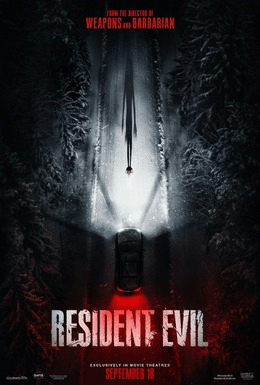
Resident Evil (2026) Movie: Cast, Story, Review, Release Date and Everything You Need to Know
Resident Evil (2026) brings Capcom’s legendary survival-horror franchise back to the big screen with a fresh protagonist, a new story and a filmmaking approach designed to capture the fear, unpredictability and dark humor associated with the games. Directed by Zach Cregger, the filmmaker behind Barbarian and Weapons, this new adaptation stars Austin Abrams as Bryan, an ordinary medical courier whose routine assignment turns into a nightmare.
Released theatrically in the United States on September 18, 2026, Resident Evil is written by Cregger and Shay Hatten. Rather than bringing back the previous films’ central characters, the movie introduces Bryan and places him in a terrifying survival scenario connected to Raccoon City.
The result is a different kind of Resident Evil movie: less interested in presenting an unstoppable action hero and more focused on what happens when an unprepared person is dropped into a world of biological experiments, infected creatures and rapidly escalating chaos.
Resident Evil (2026) Movie Details
| Movie | Resident Evil |
|---|---|
| Release Year | 2026 |
| U.S. Theatrical Release | September 18, 2026 |
| Genre | Horror, Action, Survival Horror |
| Director | Zach Cregger |
| Writers | Zach Cregger, Shay Hatten |
| Lead Actor | Austin Abrams |
| Main Cast | Austin Abrams, Zach Cherry, Kali Reis, Paul Walter Hauser, Johnno Wilson |
| Main Character | Bryan |
| Runtime | Approximately 90 minutes |
| Rating | R |
| Based On | Capcom’s Resident Evil video game franchise |
| Distributor | Columbia Pictures / Sony Pictures Releasing |
What Is Resident Evil (2026) About?
The 2026 Resident Evil centers on Bryan, a medical courier played by Austin Abrams.
Bryan is not a police officer, elite soldier or experienced monster hunter. He is an ordinary worker trying to complete an assignment, a choice that immediately separates this movie from many previous Resident Evil adaptations.
His job sends him toward Raccoon City, where a medical delivery becomes the starting point for a horrifying night.
While traveling through snowy terrain, Bryan becomes involved in a disturbing incident that initially appears manageable. It quickly becomes clear, however, that something much larger and more dangerous is happening around him.
A biological catastrophe has transformed the surrounding environment into a lethal nightmare.
Bryan soon encounters mutated creatures, infected victims and evidence of experiments connected to the disaster. With little preparation for the situation, survival becomes his only meaningful objective.
Yet escaping is not straightforward.
The deeper Bryan travels into the crisis, the more he is forced into locations where the outbreak has already taken hold. Hospitals, laboratories and isolated environments become dangerous spaces in which every corridor or closed door could conceal another threat.
That setup gives the movie a structure resembling survival-horror gameplay. Bryan progresses from one dangerous situation to another while gradually understanding the scale of the catastrophe surrounding him.
A New Resident Evil Story With Familiar DNA
One of the most important elements of Resident Evil (2026) is that it does not simply recreate one of the earlier movies.
Cregger’s film tells an all-new story within the recognizable mythology of the franchise.
At the same time, the movie has clear connections to the atmosphere and ideas associated with Resident Evil 2. Raccoon City, biological experimentation and an escalating outbreak provide familiar foundations, but Bryan allows the filmmakers to experience those ideas from a different perspective.
That distinction matters.
Instead of asking audiences to watch another established hero navigate familiar events, the film creates a protagonist who knows very little about what is happening. Bryan discovers the nightmare alongside the viewer.
It restores an important ingredient of survival horror: vulnerability.
Austin Abrams as Bryan
Austin Abrams carries much of the movie as Bryan.
The casting works because Bryan is not presented as a traditional action protagonist. Abrams plays him as someone whose reactions to danger can be frightened, awkward and occasionally funny.
That gives the film an unusual tonal identity.
A highly trained character entering Raccoon City would immediately understand how to react to danger. Bryan frequently does not. His confusion becomes part of both the suspense and the comedy.
Abrams therefore has to sell two seemingly contradictory elements: Bryan must be vulnerable enough for the horror to feel dangerous but entertaining enough to sustain a fast-moving genre film.
His performance becomes one of the movie’s defining characteristics.
Resident Evil (2026) Cast
Alongside Austin Abrams, the film features Zach Cherry, Kali Reis, Paul Walter Hauser and Johnno Wilson.
Cherry, Reis and Hauser expand the human side of a story dominated by infection and corporate experimentation, while Johnno Wilson also appears among the supporting ensemble.
Importantly, the film does not rely primarily on returning characters from earlier adaptations. That allows Cregger to establish a separate identity rather than requiring viewers to understand decades of movie continuity.
For newcomers, that makes the 2026 film relatively accessible.
For longtime fans, the recognizable world provides the connection.
Zach Cregger Brings His Horror Style to Resident Evil
Director Zach Cregger became a major contemporary horror filmmaker through his ability to manipulate audience expectations.
That quality is particularly suited to Resident Evil.
The games have always depended on uncertainty. Players enter unfamiliar spaces without knowing what is behind the next door, whether ammunition will last or when a seemingly safe environment will suddenly become dangerous.
Cinema cannot reproduce those interactive mechanics directly, but it can recreate the emotional experience.
Cregger approaches the material by emphasizing perspective, movement and sudden changes in danger. The camera occasionally evokes the visual language of video games without allowing the film to become a simple imitation of gameplay.
The movie instead translates survival-horror principles into cinematic suspense.
Horror, Gore and Creature Design
Anyone expecting Resident Evil (2026) to soften the franchise’s horror identity should expect the opposite.
The movie carries an R rating for strong bloody violence, gore and language, and its creatures are essential to the atmosphere.
The threat is not limited to conventional zombies.
Mutation has always been one of Resident Evil’s defining ideas. The franchise becomes frightening when biological science creates organisms that no longer obey familiar rules of anatomy or behavior.
The 2026 film embraces that tradition.
Its monsters contribute to an increasingly unpredictable survival experience in which Bryan cannot simply learn one strategy and repeat it.
That variety helps maintain tension throughout the relatively compact running time.
The Influence of Resident Evil 2
Although the film tells an original story, Resident Evil 2 is an important reference point.
The 1998 game famously follows characters trapped in Raccoon City during a catastrophic outbreak. Police stations, laboratories, streets and other familiar environments gradually reveal how completely the disaster has consumed the city.
Cregger’s movie uses a comparable philosophy without simply retelling Leon Kennedy and Claire Redfield’s story.
Bryan functions almost like an unseen civilian caught elsewhere in the same kind of catastrophe.
It is an effective concept because the Resident Evil universe has always implied that countless ordinary people were experiencing their own nightmares while the games’ famous protagonists fought through Raccoon City.
This movie explores what one of those stories might look like.
Direction and Visual Style
Visually, Resident Evil benefits from cinematography designed around darkness, confined spaces and environmental uncertainty.
Cinematographer Dariusz Wolski helps give the movie a polished theatrical scale while retaining the claustrophobic qualities necessary for horror.
The strongest visual sequences frequently emphasize limited information.
Audiences may see only part of a room, a distant figure or movement occurring beyond Bryan’s immediate awareness. That approach allows suspense to develop before violence begins.
The widescreen presentation also gives the filmmakers opportunities to hide threats within the frame rather than relying exclusively on conventional jump scares.
Horror and Comedy
Cregger’s background in comedy remains visible in the movie.
That does not transform Resident Evil into a parody. Instead, humor emerges naturally from Bryan’s personality and his increasingly absurd circumstances.
His reactions are often those of a frightened ordinary person rather than a fearless movie hero.
This creates a useful contrast.
The horror becomes more intense because Bryan appears vulnerable, while moments of humor prevent the film’s relentless danger from becoming monotonous.
The balance will inevitably depend on individual taste, particularly for viewers who prefer completely serious survival horror. Nevertheless, the comedic dimension gives this adaptation a personality distinct from earlier Resident Evil films.
Pacing and Runtime
At roughly 90 minutes, Resident Evil (2026) moves quickly.
The film does not spend excessive time explaining every component of its mythology before introducing danger. Once Bryan becomes trapped in the unfolding outbreak, the narrative operates like an extended survival sequence.
That compact structure suits the material.
Rather than building toward a single climactic confrontation for most of the running time, the movie repeatedly introduces new obstacles. Bryan survives one threat only to discover that something worse may be waiting nearby.
The approach resembles the escalating rhythm of a horror game without literally reproducing missions or levels.
Strengths and Weaknesses
The movie’s greatest strength is its decision to make vulnerability central again.
Bryan is frightened, inexperienced and frequently overwhelmed. That immediately creates suspense because the audience cannot assume that he has the skills necessary to survive every confrontation.
Cregger’s combination of horror, gore, comedy and game-inspired visual ideas also gives the adaptation a distinctive identity.
The relatively short runtime keeps the film energetic, although that speed occasionally works against deeper character development. Some supporting figures receive less attention than the central survival story, while the rapid escalation can leave certain narrative ideas feeling secondary to the next major horror sequence.
The humor may also divide audiences. Viewers wanting relentless, serious horror could find some comic moments disruptive, while others may consider them essential to Bryan’s personality.
How Resident Evil (2026) Differs From Previous Movies
The earlier Milla Jovovich-led films gradually became large-scale action spectacles built around Alice, a character created specifically for the movies.
Resident Evil: Welcome to Raccoon City took another approach, attempting to incorporate recognizable characters and locations from the games more directly.
Cregger’s Resident Evil chooses a third path.
It respects the universe without becoming a scene-for-scene recreation.
Bryan is new, but Raccoon City, biological horror, corporate experimentation, mutation and desperate survival remain unmistakably Resident Evil.
That combination allows the filmmakers to acknowledge established mythology while still creating uncertainty.
Is Resident Evil (2026) Connected to the Previous Movies?
The 2026 movie functions as a new reboot rather than a continuation of the Milla Jovovich series.
That means audiences do not need to watch the previous seven live-action theatrical films before seeing it.
Knowledge of the games can add context and make certain ideas more recognizable, but the central narrative is constructed around Bryan’s experience.
For viewers encountering the franchise for the first time, his lack of knowledge actually works as an introduction to the world.
Final Verdict
Resident Evil (2026) succeeds by understanding that the franchise’s most valuable cinematic ingredient is not simply zombies or recognizable game references. It is the sensation of being trapped somewhere dangerous without enough information, preparation or resources.
Zach Cregger builds his reboot around that principle.
Austin Abrams’ Bryan gives audiences a deliberately unconventional protagonist: vulnerable, occasionally funny and completely unprepared for the nightmare surrounding him. His perspective transforms Raccoon City’s biological catastrophe from familiar franchise mythology into something immediate again.
The film’s fast pace, graphic creature horror and playful relationship with video-game language make it a noticeably different Resident Evil adaptation. Its compressed structure means some characters and ideas receive less development, and its mixture of comedy and horror will not appeal equally to every viewer.
Nevertheless, the 2026 reboot establishes a clear identity rather than simply repeating what earlier adaptations have already attempted.
For a franchise built around survival, reinvention may be exactly the point.
Resident Evil (2026) FAQ
When was Resident Evil (2026) released?
Resident Evil opened theatrically in the United States on September 18, 2026, with some international markets receiving it slightly earlier.
Who directed Resident Evil (2026)?
The movie was directed by Zach Cregger, who also co-wrote the screenplay with Shay Hatten.
Who plays Bryan in Resident Evil?
Austin Abrams stars as Bryan, a medical courier caught in the biological nightmare surrounding Raccoon City.
Is Resident Evil (2026) based on Resident Evil 2?
The movie tells an original story rather than directly recreating the game, but its setting, outbreak scenario and survival-horror approach have significant connections to the world associated with Resident Evil 2.
Is Milla Jovovich in Resident Evil (2026)?
The 2026 movie introduces a new storyline and is separate from the Milla Jovovich-led film continuity.
What is the runtime of Resident Evil (2026)?
The theatrical runtime is approximately 90 minutes.
Is Resident Evil (2026) a reboot?
Yes. The film represents another cinematic reinvention of Capcom’s Resident Evil franchise rather than continuing the earlier movie continuity.
SEO Title
Resident Evil (2026) Movie: Cast, Story, Review, Release Date & Everything to Know
Meta Description
Resident Evil (2026), directed by Zach Cregger and starring Austin Abrams, reinvents Capcom’s survival-horror franchise. Explore the cast, story, runtime, release date, analysis and review.
Suggested URL Slug
resident-evil-2026-movie-cast-story-review-release-date
Review Schema (JSON-LD)
{
  "@context": "https://schema.org",
  "@type": "Review",
  "name": "Resident Evil (2026) Movie Review",
  "reviewBody": "Resident Evil (2026) reinvents Capcom's survival-horror franchise through the perspective of Bryan, an ordinary medical courier trapped in a biological nightmare. Directed by Zach Cregger and starring Austin Abrams, the film combines graphic creature horror, dark comedy and game-inspired suspense within a fast-paced survival story.",
  "itemReviewed": {
    "@type": "Movie",
    "name": "Resident Evil",
    "dateCreated": "2026",
    "datePublished": "2026-09-18",
    "duration": "PT1H30M",
    "genre": [
      "Horror",
      "Action",
      "Survival Horror"
    ],
    "director": {
      "@type": "Person",
      "name": "Zach Cregger"
    },
    "actor": [
      {
        "@type": "Person",
        "name": "Austin Abrams"
      },
      {
        "@type": "Person",
        "name": "Zach Cherry"
      },
      {
        "@type": "Person",
        "name": "Kali Reis"
      },
      {
        "@type": "Person",
        "name": "Paul Walter Hauser"
      },
      {
        "@type": "Person",
        "name": "Johnno Wilson"
      }
    ]
  },
  "author": {
    "@type": "Organization",
    "name": "Editorial Team"
  }
}