


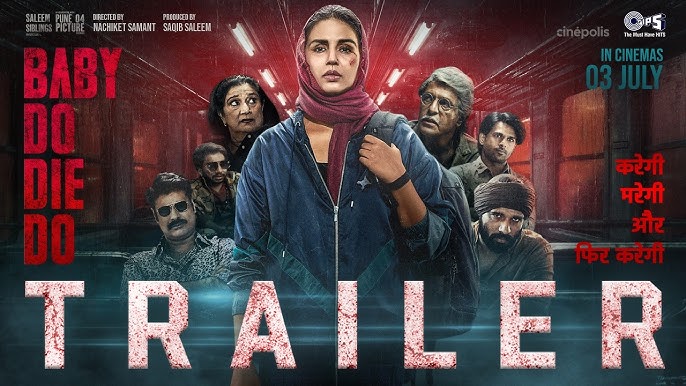
Baby Do Die Do Movie Review: Huma Qureshi Shines in a Gritty, Audacious Mumbai Neo-Noir
Director Nachiket Samant’s Baby Do Die Do (2026) arrives in theatres as a highly anticipated addition to the Indian neo-noir landscape. Produced by Saqib Saleem under the Saleem Siblings banner in association with Pune-04 Picture LLP, this dark crime comedy-thriller attempts an incredibly ambitious tonal balancing act. It positions a deaf and mute female contract killer at the epicenter of Mumbai’s chaotic underworld, driving a narrative fueled by psychological trauma, dark wit, and high-octane violence.
Bolstered by a stellar ensemble cast including Sikandar Kher, Chunky Panday, Seema Pahwa, and Rachit Singh, Baby Do Die Do offers a stylized, sonic-driven cinematic experience that explores the heavy price of survival in an unforgiving metropolis.
Complete Overview and Production Data
For cinephiles and industry trackers analyzing the film’s market footprint, the primary production details are laid out below:
| Technical & Creative Attributes | Film Specifications & Credits |
| Title | Baby Do Die Do |
| Release Date | July 3, 2026 |
| Director | Nachiket Samant |
| Producers | Saqib Saleem (Saleem Siblings), Pune-04 Picture LLP |
| Lead Cast | Huma Qureshi, Sikandar Kher, Chunky Panday, Seema Pahwa |
| Supporting Cast | Rachit Singh, Vidya Malvade, Himanshu Malik, Arun Kushwah |
| Screenplay & Dialogues | Nachiket Samant, Gaurav Sharma |
| Original Story | Parveez Shaikh, Jasmeet K. Reen |
| Cinematographer | Tojo Xavier |
| Music Director | Arjun Iyer |
| Runtime | 2 Hours 5 Minutes |
| Language & Certification | Hindi / ‘A’ (Adults Only) |
Detailed Plot Synopsis
The narrative centers around Baby KarMarKar (Huma Qureshi), an enigmatic young woman navigating the overwhelming, sensory-overload sprawl of Mumbai. To the outer world, Baby is a quiet, unassuming deaf and mute citizen trying to scrape by. In reality, she operates under the shadows as India’s first notorious female contract killer, working deep within a treacherous underworld ecosystem.
Baby’s psychological reality is deeply fractured. Though she cannot hear the world around her, her mind is dominated by a singular audio phenomenon: the persistent, guiding voice of her deceased sister. This auditory hallucination acts as both her moral compass and her trigger, instructing her movements and dictating the execution of her targets for reasons shrouded in long-buried family secrets.
The status quo shatters when a high-profile hit goes catastrophically wrong. The botched execution sets off a domino effect of institutional betrayal, putting Baby directly in the crosshairs of ruthless gang lords and an obsessive police force. As she flees through Mumbai’s claustrophobic alleyways, ghosts from her past resurface, forcing her to confront a web of childhood trauma and identity theft.
Flanked by volatile criminal elements—including a menacing enforcer played by Sikandar Kher and a eccentric underworld figure portrayed by Chunky Panday—Baby must decipher who orchestrated her setup. Her journey transforms from a cold-blooded survival mission into a desperate quest for autonomy and vengeance.
Deep-Dive Cinematic Critique
Themes and Screenplay Architecture
The screenplay, co-written by Nachiket Samant and Gaurav Sharma based on a story by Parveez Shaikh and Jasmeet K. Reen, successfully interrogates themes of isolation, systemic exploitation, and the heavy burden of unprocessed grief. By framing the narrative around a protagonist lacking conventional speech, the script leverages visual storytelling over exposition.
The inclusion of the sister’s voice is an effective narrative device, though it occasionally flirts with over-explaining plot points that the cinematography successfully conveys on its own. The script’s tonal shift between bleak, graphic thriller elements and pitch-black comedy represents an audacious attempt to replicate classic neo-noir tropes within a distinctly Indian urban framework.
Acting and Character Portrayals
Huma Qureshi delivers a towering, physically demanding performance that ranks among the finest of her career. Deprived of spoken dialogue, Qureshi relies entirely on micro-expressions, piercing gaze shifts, and highly controlled body language to communicate Baby’s internal torment and lethal precision. She anchors the film’s emotional weight effortlessly.
Performance Highlight: Huma Qureshi communicates complex underworld negotiations entirely through kinetic sign language and calculated, icy stillness.
Sikandar Kher brings a terrifying, grounded physicality to his role, maintaining a palpable sense of danger whenever he occupies the frame. Chunky Panday continues his impressive mid-career renaissance, delivering an eccentric, darkly comedic turn that provides welcome relief to the otherwise oppressive atmosphere. Seema Pahwa is equally exceptional, subverting her traditional maternal archetype to play a calculating, stone-cold underworld operative.
Direction and Visual Aesthetic
Nachiket Samant exhibits great technical maturity in building an atmospheric Mumbai. Working closely with Director of Photography Tojo Xavier, Samant captures the city not as a postcard backdrop, but as an overwhelming, claustrophobic labyrinth.
The color palette is rich with saturated neon blues, deep crimson tones, and sickly sodium-vapor greens, mirroring Baby’s psychological disorientation. The use of innovative camera angles captures the kinetic energy of Mumbai’s crowded transit hubs, effectively simulating the sensory overload that the protagonist constantly battles.
Sound Design and Musicality
Given the protagonist’s condition, the sound design by Shantanu Yennemadi and mixing by Sudeepta Sadhukhan serve as vital narrative engines. The audio shifts brilliantly between dead, muffled silences—representing Baby’s physical reality—and the hyper-crisp, echoing timbre of her sister’s voice.
Arjun Iyer’s musical score complements this perfectly, blending electronic industrial beats with traditional rhythms. The film also features a highly energetic, contemporary reimagining of the classic track “Ishq Kameena” choreographed by Remo D’Souza. Featuring Qureshi and Rachit Singh, the sequence serves as a stylish, high-octane visual interlude that contrasts effectively with the film’s darker narrative passages.
Comprehensive Strengths and Weaknesses
Strengths
-
Masterful Lead Performance: Huma Qureshi’s non-verbal execution balances brutal lethal action with profound emotional vulnerability.
-
Inventive Soundscapes: The creative audio design effectively pulls the audience directly into the main character’s subjective, sensory experience.
-
Stellar Ensemble Cast: Veteran actors like Chunky Panday and Seema Pahwa deliver highly memorable, subverted character performances.
-
Striking Neon Visuals: Tojo Xavier’s sharp, stylized cinematography transforms Mumbai into a living, breathing neo-noir landscape.
Weaknesses
-
Tonal Volatility: The abrupt transitions between grim thriller violence and dark comedy can occasionally feel jarring for traditional audiences.
-
Pacing Lag in Act Two: The midsection slows down unnecessarily as it deepens the complex lore of the childhood trauma backstory.
-
Over-reliance on Auditory Guiding: The voiceover of the dead sister is occasionally overused to clarify plot points that were already visually clear.
Final Verdict
Baby Do Die Do is an uncommonly bold, technically accomplished crime thriller that breaks away from conventional Bollywood structures. While its erratic tonal shifts and dense second-act exposition prevent it from achieving absolute perfection, the film is overwhelmingly salvaged by Nachiket Samant’s visionary direction, immersive sound engineering, and a career-best physical performance from Huma Qureshi. It is an essential watch for enthusiasts of stylized international noir and modern Indian independent cinema.