


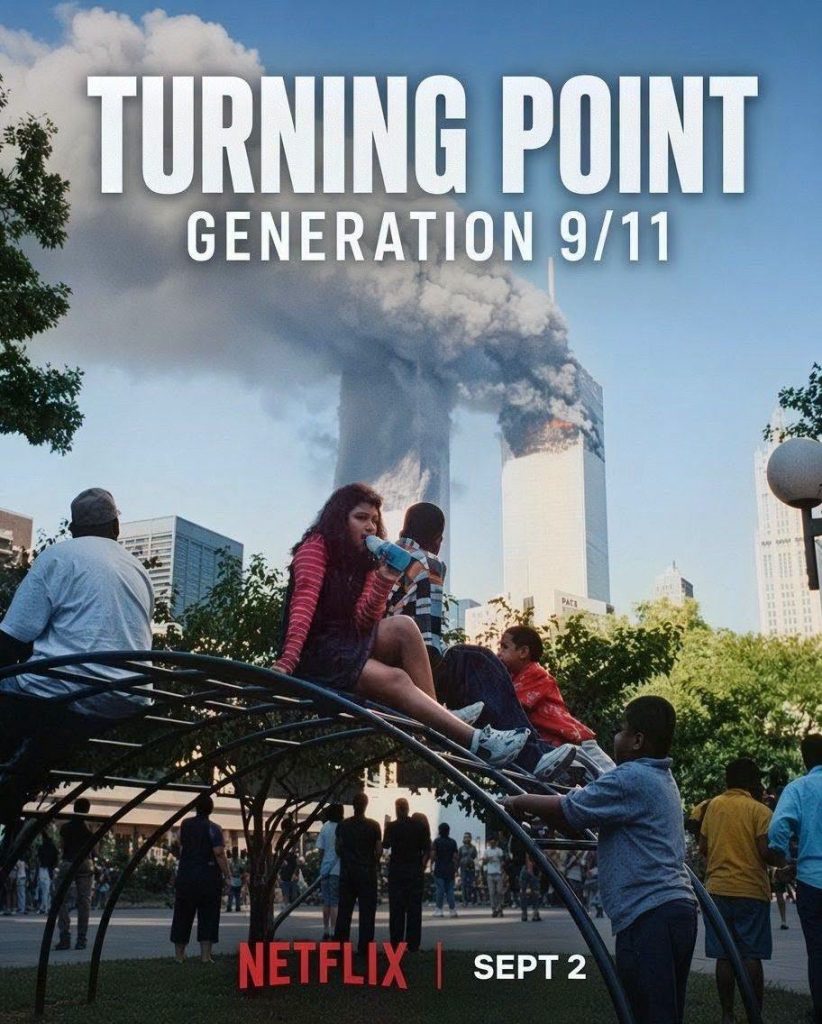
Turning Point: Generation 9/11 (2026): Netflix Documentary Explores the Lasting Legacy of September 11
Turning Point: Generation 9/11 is a 2026 Netflix documentary directed by Brian Knappenberger that examines how the September 11, 2001 terrorist attacks continued to shape lives, politics, war, technology, and American society long after the immediate tragedy had passed.
Released on September 2, 2026, shortly before the 25th anniversary of 9/11, the documentary shifts the conversation away from simply reconstructing what happened on that morning. Instead, it focuses on the generation that inherited its consequences.
Through firsthand testimony from people whose lives were transformed by the attacks and the War on Terror, Turning Point: Generation 9/11 explores personal loss alongside much larger questions about Afghanistan, military service, surveillance, misinformation, national identity, and the political atmosphere created in the decades after September 11.
For viewers searching for a new Netflix 9/11 documentary, the film offers a contemporary examination of why an event from 2001 remains deeply connected to the world of 2026.
Turning Point: Generation 9/11 Movie Details
| Detail | Information |
|---|---|
| Title | Turning Point: Generation 9/11 |
| Year | 2026 |
| Genre | Documentary, History, Political Documentary |
| Director | Brian Knappenberger |
| Narrator | Josh Brolin |
| Executive Producers | Brian Knappenberger, Clare Tucker, Jennifer Janisch, Alison Klayman, Sarah Huisenga |
| Production Company | Luminant Media |
| Distributor | Netflix |
| Country | United States |
| Language | English |
| Runtime | 1 hour 37 minutes |
| Release Date | September 2, 2026 |
| Streaming Platform | Netflix |
What Is Turning Point: Generation 9/11 About?
Twenty-five years after September 11, Turning Point: Generation 9/11 asks a deceptively simple question: What does 9/11 mean to a generation that may not actually remember it?
For millions of Americans, September 11 remains a vivid personal memory. For younger generations, however, it increasingly exists as history—something encountered through photographs, documentaries, memorials, classrooms, political debates, and stories passed down by parents.
Knappenberger’s documentary bridges those two perspectives.
Rather than concentrating entirely on the attacks themselves, the film follows the consequences outward. It considers children who lost parents on 9/11, journalists whose careers developed during the War on Terror, young Afghans who grew up amid decades of conflict, and U.S. Marines confronting the consequences of America’s withdrawal from Afghanistan in 2021.
Their experiences demonstrate how the historical importance of September 11 cannot be confined to one date.
The film’s central argument is that 9/11 created consequences that unfolded across decades.
Turning Point: Generation 9/11 Synopsis
The documentary begins from the historical trauma of September 11, 2001, when coordinated terrorist attacks targeted the United States and fundamentally altered the country’s political and security priorities.
But Generation 9/11 is less interested in recreating the familiar chronology than in tracing what followed.
Personal accounts connect the attacks to families permanently altered by loss. Among the documentary’s subjects are members of a younger generation whose identities were shaped by parents they lost or by stories surrounding a day they were too young to fully understand.
From these intimate experiences, the documentary expands its scope.
The attacks initiated an enormous political and military response. The United States entered Afghanistan, launched the broader War on Terror, expanded national-security policies and surveillance powers, and entered an era in which terrorism became a defining element of political discussion.
Journalists who began their careers during this period offer another perspective. Their experiences reveal how September 11 transformed not only government policy but also the media environment through which Americans understood war, national security, political power, and fear.
The documentary then turns toward Afghanistan.
For young Afghans, the consequences of September 11 were dramatically different but equally significant. They grew up within a country transformed by international military intervention, political reconstruction, instability, and eventually the Taliban’s return to power.
The 2021 U.S. withdrawal from Afghanistan becomes an important endpoint in this historical journey.
Young American Marines and Afghans confronting the chaotic conclusion of America’s longest war provide the documentary with one of its strongest connections between generations. Events that began before some of them were old enough to understand world politics ultimately determined where they would serve, what risks they would face, and what kind of country they inherited.
A Documentary About Consequences Rather Than Memory
One of the most compelling ideas behind Turning Point: Generation 9/11 is the distinction between remembering history and inheriting it.
A person does not need to remember September 11 to live inside the world it helped create.
The documentary examines this concept across several interconnected subjects: military intervention, surveillance, political polarization, conspiracy culture, digital misinformation, immigration, national security, and American identity.
This makes the film broader than a traditional historical documentary.
September 11 functions as its starting point, but the real subject is the chain reaction that followed.
Brian Knappenberger Returns to the Turning Point Franchise
Director Brian Knappenberger has repeatedly examined the relationship between major historical events and the systems that emerge around them.
His earlier Netflix series Turning Point: 9/11 and the War on Terror offered a much larger chronological examination of the attacks, their geopolitical origins, and America’s subsequent military response.
Turning Point: Generation 9/11 approaches the subject from another direction.
Instead of asking primarily how 9/11 happened, the 2026 documentary asks what happened to the people who grew up afterward.
That distinction gives the film its identity.
Knappenberger combines historical context with testimony, allowing large geopolitical developments to be understood through individual lives. The strategy keeps the documentary from becoming simply another overview of familiar historical events.
The Human Cost of History
The documentary is strongest when enormous political decisions become personal.
Terms such as “War on Terror,” “Afghanistan withdrawal,” and “national security” can sound abstract after decades of repetition. Generation 9/11 attempts to restore their human dimensions.
Children lost parents.
Military personnel inherited wars launched when they were children.
Journalists built careers around conflicts that lasted for decades.
Afghans experienced political promises, occupation, instability, violence, withdrawal, and the Taliban’s return.
Seen together, these stories emphasize one of the documentary’s central observations: history does not end when the headlines change.
Its consequences move through families and generations.
September 11 and the Transformation of American Society
The documentary also explores how the attacks altered American political culture.
The years after September 11 produced major debates surrounding security and civil liberties. Government surveillance expanded, executive authority became a central political issue, and fears surrounding terrorism influenced domestic policy.
At the same time, the internet was transforming how information moved.
That technological shift would eventually create an information ecosystem dominated by social media, algorithmic distribution, fragmented news audiences, conspiracy theories, and increasingly aggressive political discourse.
By examining these developments alongside the legacy of 9/11, the documentary suggests that the attacks influenced more than foreign policy.
They helped shape the psychological and political environment of twenty-first-century America.
Afghanistan and the Long Shadow of the War on Terror
Afghanistan provides the film with its clearest demonstration of how historical consequences can extend across generations.
The U.S.-led intervention began shortly after the attacks in 2001. What initially appeared to be a relatively direct military response developed into a conflict lasting approximately two decades.
During that period, an entire generation came of age.
For Americans, that included service members who eventually deployed to a war that began when they were children.
For Afghans, it meant growing up amid enormous political and social change.
The American withdrawal in 2021 therefore represents more than the conclusion of a military operation within the documentary. It becomes the final chapter of a political era that began with September 11.
Images and memories associated with the withdrawal underline the film’s larger argument: decisions made during moments of national trauma can produce consequences lasting far beyond the people who originally made them.
Why Turning Point: Generation 9/11 Matters in 2026
The documentary’s timing is essential.
September 2026 marks 25 years since the September 11 attacks.
That anniversary represents an important generational threshold. Increasing numbers of adults now have little or no personal memory of the event, even though many aspects of the political world they inherited were shaped by it.
This creates a challenge for historical storytelling.
How should September 11 be explained when it begins moving from living memory into history?
Turning Point: Generation 9/11 answers by focusing on consequences.
Instead of insisting that younger viewers experience the event emotionally in the same way previous generations did, the documentary demonstrates how decisions made afterward continue to affect their lives.
That approach gives the film particular relevance for younger audiences.
Turning Point: Generation 9/11 Review
As a documentary, Turning Point: Generation 9/11 succeeds because it understands that the most familiar images of September 11 are no longer enough to explain its significance.
The film’s greatest strength is perspective.
By focusing on people who inherited the post-9/11 world, Knappenberger avoids creating a simple commemorative documentary. Personal testimony gives the historical material emotional weight, while the broader political context prevents those stories from existing in isolation.
Josh Brolin’s narration provides additional continuity without overwhelming the subjects.
The 97-minute runtime also forces the documentary to move efficiently between personal stories and geopolitical history.
That efficiency occasionally becomes a limitation.
Subjects such as surveillance, misinformation, Afghanistan, military intervention, conspiracy culture, and American political polarization could each support a feature-length documentary of their own. Compressing them into a single film inevitably means that certain ideas receive less examination than their complexity deserves.
Yet the documentary’s purpose is ultimately synthesis rather than exhaustive historical analysis.
It wants viewers to see connections.
And in that respect, it is effective.
Strengths and Weaknesses
Strengths
Powerful firsthand testimony: Personal experiences prevent the documentary’s geopolitical discussion from becoming overly abstract.
Strong generational perspective: Focusing on people who inherited the consequences of September 11 distinguishes the film from conventional anniversary documentaries.
Relevant historical context: The documentary connects 2001 with Afghanistan, surveillance, misinformation, political division, and the modern digital environment.
Focused direction: Brian Knappenberger brings experience with complicated political subjects and organizes an enormous historical topic around a clear central idea.
Timely release: Arriving during the 25th anniversary year gives the documentary significant historical relevance.
Weaknesses
Extremely broad subject matter: Covering 25 years of political, military, technological, and cultural change in 97 minutes inevitably limits depth.
Some subjects deserve more exploration: Afghanistan, surveillance policy, conspiracy movements, and post-9/11 political changes could each support much longer analysis.
Heavy emotional material: The subject matter includes terrorism, war, death, grief, and traumatic memories that may be difficult for some viewers.
Is Turning Point: Generation 9/11 Worth Watching?
Yes, particularly for viewers interested in modern history, American politics, documentaries about September 11, and the long-term consequences of the War on Terror.
It may be especially valuable for younger audiences who know 9/11 primarily as a historical event rather than a personal memory.
The documentary does not require viewers to have seen the earlier Turning Point: 9/11 and the War on Terror, although watching the 2021 series can provide additional historical context.
The new film stands on its own by concentrating on a different question: not simply what happened, but what was inherited.
Where to Watch Turning Point: Generation 9/11
Turning Point: Generation 9/11 premiered on Netflix on September 2, 2026.
The documentary runs approximately 1 hour and 37 minutes and is presented as a feature-length installment in Netflix’s Turning Point documentary franchise.
Final Verdict
Turning Point: Generation 9/11 is an ambitious and timely documentary about the distance between historical memory and historical consequence.
Brian Knappenberger avoids treating September 11 as an isolated event frozen in 2001. Instead, he traces its influence through families, journalists, soldiers, Afghans, political institutions, technological change, and a younger generation that inherited the aftermath.
Its 97-minute runtime prevents every subject from receiving exhaustive treatment, but the documentary’s wider argument remains persuasive: the true legacy of a historical event cannot be measured only by what happened on the day itself.
Twenty-five years later, September 11 belongs increasingly to history.
Its consequences do not.
Rating: 8/10
Frequently Asked Questions
When was Turning Point: Generation 9/11 released?
Turning Point: Generation 9/11 was released on September 2, 2026.
Where can I watch Turning Point: Generation 9/11?
The documentary is available on Netflix.
Who directed Turning Point: Generation 9/11?
The documentary was directed by Brian Knappenberger.
Who narrates Turning Point: Generation 9/11?
Josh Brolin is credited as the documentary’s narrator.
How long is Turning Point: Generation 9/11?
The documentary has a runtime of approximately 97 minutes, or 1 hour and 37 minutes.
What is Turning Point: Generation 9/11 about?
The film explores the lasting impact of September 11 on the generation that grew up after the attacks, including children who lost parents, journalists shaped by the War on Terror, young Afghans, and U.S. Marines affected by the withdrawal from Afghanistan.
Is Turning Point: Generation 9/11 connected to the 2021 Netflix series?
Yes. It is part of the broader Netflix Turning Point documentary franchise associated with Brian Knappenberger. The earlier Turning Point: 9/11 and the War on Terror examined the attacks and their geopolitical aftermath in greater chronological detail.
SEO Meta Information
SEO Title: Turning Point: Generation 9/11 (2026) Review, Synopsis & Netflix Documentary Guide
Meta Description: Turning Point: Generation 9/11 is a 2026 Netflix documentary directed by Brian Knappenberger exploring how 9/11 shaped a generation, the War on Terror, Afghanistan and modern America.
Focus Keyphrase: Turning Point Generation 9/11
Secondary Keywords: Turning Point Generation 9/11 review, Turning Point Generation 9/11 Netflix, Generation 9/11 documentary, Netflix 9/11 documentary 2026, Turning Point Generation 9/11 synopsis, Brian Knappenberger documentary, September 11 documentary, 9/11 25th anniversary documentary
Suggested URL Slug: turning-point-generation-9-11-2026-review
Review Schema (JSON-LD)
{
  "@context": "https://schema.org",
  "@type": "Review",
  "name": "Turning Point: Generation 9/11 (2026) Review",
  "itemReviewed": {
    "@type": "Movie",
    "name": "Turning Point: Generation 9/11",
    "dateCreated": "2026",
    "datePublished": "2026-09-02",
    "duration": "PT1H37M",
    "genre": [
      "Documentary",
      "History",
      "Political Documentary"
    ],
    "inLanguage": "en",
    "countryOfOrigin": {
      "@type": "Country",
      "name": "United States"
    },
    "director": {
      "@type": "Person",
      "name": "Brian Knappenberger"
    },
    "actor": {
      "@type": "Person",
      "name": "Josh Brolin"
    },
    "productionCompany": {
      "@type": "Organization",
      "name": "Luminant Media"
    }
  },
  "reviewRating": {
    "@type": "Rating",
    "ratingValue": "8",
    "bestRating": "10",
    "worstRating": "1"
  },
  "author": {
    "@type": "Person",
    "name": "Editorial Team"
  },
  "reviewBody": "Turning Point: Generation 9/11 is a timely and ambitious Netflix documentary examining how the September 11 attacks shaped a generation that inherited their political, military and cultural consequences."
}