


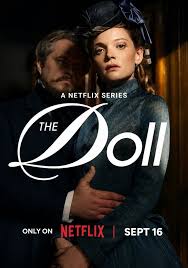
The Doll Season 1 (2026): Cast, Story, Release Date and Everything to Know About the Netflix Period Drama
The Doll Season 1 brings one of Poland’s most celebrated literary works to Netflix as an ambitious historical drama about desire, class, wealth and the dangerous pursuit of social acceptance. Released in 2026, the Polish limited series is a contemporary reinterpretation of Bolesław Prus’s classic novel Lalka, placing the complicated relationship between Stanisław Wokulski and Izabela Łęcka at the heart of its story.
Directed by Paweł Maślona, The Doll combines romance with social commentary, examining a society in which money can purchase influence but cannot necessarily erase the barriers created by birth and class.
Tomasz Schuchardt stars as Stanisław Wokulski, a self-made merchant determined to climb the social hierarchy, while Sandra Drzymalska plays Izabela Łęcka, an aristocratic woman struggling against the expectations imposed on her.
For viewers looking for a sweeping European period drama with complicated characters, romantic obsession and social conflict, The Doll Season 1 offers a story in which love and ambition are almost impossible to separate.
The Doll Season 1 Quick Facts
| Detail | Information |
|---|---|
| Title | The Doll |
| Original Title | Lalka |
| Year | 2026 |
| Format | Limited Series |
| Genre | Drama, Romance, Period Drama |
| Country | Poland |
| Original Language | Polish |
| Release Date | September 16, 2026 |
| Streaming Platform | Netflix |
| Director | Paweł Maślona |
| Based On | Lalka by Bolesław Prus |
| Main Cast | Tomasz Schuchardt, Sandra Drzymalska, Jacek Braciak, Dariusz Chojnacki |
| Episodes | 6 |
| Production Company | Akson Studio |
What Is The Doll Season 1 About?
Set against the social divisions of 19th-century Poland, The Doll centers on Stanisław Wokulski, a merchant who has risen far beyond the circumstances into which he was born.
Wokulski has accumulated considerable wealth, but financial success does not automatically provide him with the status he desires. Aristocratic society remains protected by traditions, family names and social expectations that money alone cannot easily overcome.
His ambitions become inseparable from his fascination with Izabela Łęcka, a beautiful and strong-willed aristocrat.
For Stanisław, Izabela represents more than romantic desire. She also embodies the privileged social world that remains tantalizingly close but culturally distant from him. His pursuit of her consequently develops into a complicated mixture of love, obsession, ambition and aspiration.
Izabela faces a different struggle.
Born into aristocratic society, she possesses social prestige but finds herself constrained by the expectations attached to her position. Her future is shaped by family responsibilities, marriage prospects and traditions that leave women with limited control over their own identities.
The relationship between Stanisław and Izabela therefore becomes the series’ central contradiction: he desperately wants access to the world into which she was born, while she increasingly wants freedom from the rules governing that same world.
The Doll Season 1 Story and Synopsis
The story begins after Stanisław Wokulski has made a fortune through wartime business opportunities. Returning to Poland as a wealthy merchant, he focuses much of his attention on winning Izabela Łęcka.
Yet his financial achievements cannot eliminate the social distance separating them.
Izabela belongs to an aristocratic family whose status remains important even as its financial security begins to deteriorate. The tension between wealth and inherited prestige creates an opportunity for Stanisław, who believes his fortune may finally open doors that were previously closed to him.
But Izabela is not simply an object of his affection.
She has ambitions of her own, including intellectual and creative aspirations that clash with the limited role society expects her to occupy. As Stanisław attempts to move closer to her family, Izabela begins recognizing ways in which his devotion might help her pursue greater independence.
Their relationship consequently becomes an unstable exchange of desire, opportunity and power.
Stanisław’s increasing prominence gives him access to influential social circles, but every step forward exposes another contradiction within the class system. Money can rescue struggling aristocrats and create economic power, yet established elites remain reluctant to consider wealthy outsiders their equals.
Izabela simultaneously begins encountering realities beyond the protected environment of privilege.
As circumstances change, both characters are forced to confront the assumptions that have shaped their lives. Stanisław must determine whether the social acceptance he desires is genuinely achievable, while Izabela must consider what freedom actually means when financial survival and social reputation remain powerful forces.
By turning their romance into a broader examination of class and personal autonomy, The Doll becomes much more than a conventional period love story.
The Doll Season 1 Cast
Tomasz Schuchardt as Stanisław Wokulski
Tomasz Schuchardt leads the series as Stanisław Wokulski, an ambitious merchant whose rise in wealth cannot completely overcome the rigid boundaries of aristocratic society.
Wokulski is built around contradictions. He is practical enough to succeed in business yet idealistic enough to become consumed by romantic desire. His attraction to Izabela gradually becomes connected to his determination to prove that he belongs among society’s elite.
That tension makes him the dramatic engine of the series.
Sandra Drzymalska as Izabela Łęcka
Sandra Drzymalska plays Izabela Łęcka, whose position within the aristocracy initially appears privileged but carries significant restrictions.
The adaptation gives considerable attention to Izabela’s desire for independence and self-definition. Instead of functioning merely as the distant woman Wokulski wants to possess, she becomes an active participant in the story’s exploration of freedom, gender and social expectations.
Jacek Braciak as Tomasz Łęcki
Jacek Braciak portrays Tomasz Łęcki, Izabela’s father. His circumstances illustrate one of the story’s central ironies: aristocratic prestige may survive even when the financial foundations supporting it begin to disappear.
Dariusz Chojnacki as Ignacy Rzecki
Dariusz Chojnacki appears as Ignacy Rzecki, an important figure in Wokulski’s world and another connection to the wider political and social environment surrounding the central romance.
The ensemble also includes performers such as Magdalena Cielecka, Julia Wyszyńska, Mateusz Król and Małgorzata Hajewska-Krzysztofik, expanding the series beyond its central relationship into a portrait of a larger society undergoing change.
A Modern Adaptation of Bolesław Prus’s Lalka
One of the most important elements of The Doll Season 1 is its literary foundation.
Bolesław Prus’s Lalka is a major work of Polish literature, combining romantic tragedy with observations about class, economics, politics and social transformation.
Rather than treating the novel purely as historical material, the Netflix adaptation emphasizes ideas that remain recognizable to modern audiences.
Social mobility is one of them.
Wokulski has money but discovers that economic success and social acceptance are different forms of power. His experiences raise a question that remains central to the drama: Can wealth truly overcome class?
The answer is complicated because the aristocracy itself depends increasingly on people with the financial resources that Wokulski possesses.
Love, Obsession and Social Ambition
Romance may provide The Doll with its emotional framework, but obsession gives the story its darker edge.
Wokulski’s feelings for Izabela become intertwined with his aspirations.
She represents beauty and romantic fulfillment, but she also symbolizes entry into a social class that has historically remained beyond his reach. His pursuit therefore carries both emotional and social meaning.
This distinction matters because the series repeatedly questions whether Stanisław loves Izabela as an individual or has transformed her into an ideal representing everything he wants.
That ambiguity gives the title The Doll additional significance.
The concept of a person being transformed into an idealized object runs throughout the story, particularly when romantic desire collides with expectations about class and gender.
Izabela and the Search for Independence
Izabela’s storyline provides an important counterpoint to Wokulski’s ambitions.
While Stanisław wants to enter aristocratic society, Izabela experiences firsthand how restrictive that society can be.
Her status gives her privileges unavailable to many others, but those advantages come with expectations surrounding marriage, reputation and obedience to social convention.
The series therefore places its protagonists on opposite sides of the same structure.
Wokulski wants admission. Izabela wants autonomy.
Their attraction brings those conflicting desires together, creating a relationship shaped by much larger forces than romance.
The Doll Season 1 Themes
Class and Social Mobility
The conflict between inherited status and newly acquired wealth sits at the center of The Doll. Wokulski demonstrates that economic power can change a person’s circumstances without necessarily changing how established society views them.
Wealth and Power
Money repeatedly influences relationships throughout the story. Characters who appear socially powerful may be financially vulnerable, while those possessing significant wealth can remain socially excluded.
The result is a world where prestige and economic reality frequently contradict one another.
Romantic Idealization
Wokulski’s obsession demonstrates the danger of turning another person into an imagined ideal. The greater his emotional investment becomes, the harder it is to separate the real Izabela from the version of her created by his expectations.
Women’s Independence
Izabela’s desire to define her own future introduces questions about gender and autonomy. Her conflict is not simply about choosing between romantic partners; it concerns whether she can establish an identity outside the expectations attached to her aristocratic background.
Direction and Visual Style
Director Paweł Maślona approaches The Doll as both a period drama and a character study.
The historical setting provides an elegant visual framework, but the central conflicts remain psychological and social. Architecture, interiors and costumes reinforce differences in status, while the changing environments surrounding the protagonists reflect their movement between different levels of society.
Rather than relying entirely on the grandeur typically associated with costume dramas, the series uses its historical world to emphasize inequality.
The polished environments of aristocratic life stand against spaces associated with commerce and ordinary urban existence, helping make class division visible rather than merely discussed.
Why The Doll Stands Out Among Netflix Period Dramas
The Doll Season 1 arrives with several qualities that distinguish it from conventional romantic costume dramas.
Its central relationship is deliberately complicated. Stanisław’s pursuit of Izabela cannot easily be separated from his social ambition, while Izabela’s response to him is influenced by her own struggle for independence.
That complexity prevents the story from becoming a simple romance between characters divided by class.
Instead, The Doll asks what happens when romantic desire, money, social prestige and personal freedom all become part of the same negotiation.
Its Polish setting also gives international audiences an opportunity to experience a literary story deeply connected to the country’s cultural history while addressing themes that extend far beyond one historical period.
Is The Doll Season 1 Worth Watching?
Viewers who enjoy character-driven historical dramas are likely to find plenty of interest in The Doll.
The series prioritizes relationships, social tension and gradual character development rather than constant action. Its appeal lies in watching ambition and desire collide with a social system designed to preserve existing hierarchies.
Audiences who enjoyed European period dramas dealing with class, forbidden relationships and changing social structures should find its central conflicts familiar, even if the historical setting is less commonly represented on international streaming platforms.
Final Verdict
The Doll Season 1 transforms Bolesław Prus’s classic novel into a polished Netflix historical drama centered on the complicated intersection of love and social ambition.
Tomasz Schuchardt’s Stanisław Wokulski embodies the contradictions of a self-made man who possesses enormous financial power but remains fascinated by a social class reluctant to accept him. Sandra Drzymalska’s Izabela Łęcka provides the essential counterbalance: a woman born into the world Stanisław desperately wants to enter, yet determined to find an identity beyond its restrictive expectations.
Their relationship allows the series to explore class inequality, wealth, romantic idealization, gender and the uncertain meaning of social progress.
Rather than presenting its central romance as an escape from society, The Doll makes society inseparable from romance. Every attraction carries consequences, every financial decision changes the balance of power, and every attempt at freedom encounters another social boundary.
For Netflix viewers looking for an emotionally layered European period drama, The Doll Season 1 is a distinctive literary adaptation built around obsession, ambition and the price of belonging.
Frequently Asked Questions About The Doll Season 1
When was The Doll Season 1 released?
The Doll was released on September 16, 2026.
Where can I watch The Doll Season 1?
The series is available on Netflix.
Is The Doll based on a book?
Yes. The series is a modern television adaptation of Bolesław Prus’s classic Polish novel Lalka.
Who plays Stanisław Wokulski in The Doll?
Tomasz Schuchardt stars as Stanisław Wokulski.
Who plays Izabela Łęcka?
Sandra Drzymalska portrays Izabela Łęcka.
Who directed The Doll?
The series is directed by Paweł Maślona.
Is The Doll a romance?
Yes, but it combines romance with historical drama and social commentary. The story explores unrequited love, obsession, class divisions, wealth and personal freedom.
Is The Doll a limited series?
Yes. Netflix presents The Doll as a limited series.
Review Schema (JSON-LD)
{
  "@context": "https://schema.org",
  "@type": "TVSeries",
  "name": "The Doll",
  "alternateName": "Lalka",
  "datePublished": "2026-09-16",
  "genre": [
    "Drama",
    "Romance",
    "Period Drama"
  ],
  "inLanguage": "pl",
  "countryOfOrigin": {
    "@type": "Country",
    "name": "Poland"
  },
  "director": {
    "@type": "Person",
    "name": "Paweł Maślona"
  },
  "actor": [
    {
      "@type": "Person",
      "name": "Tomasz Schuchardt"
    },
    {
      "@type": "Person",
      "name": "Sandra Drzymalska"
    },
    {
      "@type": "Person",
      "name": "Jacek Braciak"
    },
    {
      "@type": "Person",
      "name": "Dariusz Chojnacki"
    },
    {
      "@type": "Person",
      "name": "Magdalena Cielecka"
    }
  ],
  "numberOfSeasons": 1,
  "numberOfEpisodes": 6,
  "isBasedOn": {
    "@type": "Book",
    "name": "Lalka",
    "author": {
      "@type": "Person",
      "name": "Bolesław Prus"
    }
  },
  "productionCompany": {
    "@type": "Organization",
    "name": "Akson Studio"
  },
  "description": "The Doll is a 2026 Polish Netflix period drama based on Bolesław Prus's classic novel Lalka. The series follows wealthy merchant Stanisław Wokulski and his obsessive attraction to aristocrat Izabela Łęcka against a backdrop of class division, ambition and social change."
}