


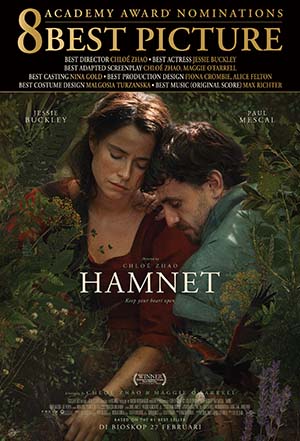
Hamnet (2025) Review: Chloé Zhao Reimagines Shakespeare Through the Lens of Maternal Grief
The intersection of historical fact and literary myth provides a fertile ground for modern cinema, yet few stories carry the weight of Hamnet. Directed by Academy Award-winner Chloé Zhao (Nomadland) and based on the best-selling 2020 novel by Maggie O’Farrell, this 2025 biographical drama strips away the “Bard of Avon” persona to reveal a raw, visceral portrait of a family in mourning. Starring Jessie Buckley and Paul Mescal, Hamnet is an atmospheric exploration of how the death of an eleven-year-old boy became the silent heartbeat of Western literature’s most famous tragedy.
Film Overview: Cast, Crew, and Production Details
Before diving into the narrative, it is essential to understand the powerhouse collaboration that brought this Elizabethan world to life.
| Feature | Details |
| Title | Hamnet |
| Release Date | November 26, 2025 (USA), January 9, 2026 (UK) |
| Director | Chloé Zhao |
| Screenplay | Chloé Zhao and Maggie O’Farrell |
| Starring | Jessie Buckley, Paul Mescal, Emily Watson, Joe Alwyn |
| Runtime | 126 minutes |
| Genre | Biographical Period Drama |
| Cinematography | Łukasz Żal |
| Music | Max Richter |
Full Plot Synopsis
Set in the 1580s and 90s in Stratford-upon-Avon, Hamnet follows the unconventional romance and tragic family life of Agnes (Anne) Hathaway (Jessie Buckley) and a young, struggling Latin tutor—the man who would become William Shakespeare (Paul Mescal).
The story begins with Agnes, a woman of the woods with an intuitive, almost supernatural connection to nature and healing. She is an outlier in her community, perceived as a “pagan” by the more rigid townspeople. When she meets the “pasty-faced scholar” William, their connection is immediate and elemental. Despite the disapproval of their families, they marry, and Agnes soon gives birth to their first child, Susanna, followed by twins: Hamnet and Judith.
As William’s theatrical ambitions draw him to the burgeoning stage world of London, Agnes remains in Stratford, anchoring the household and raising their three children. The narrative reaches its breaking point when the bubonic plague—carried by a flea on a ship from distant lands—reaches their doorstep.
In a devastating sequence, young Judith falls ill. Her twin, Hamnet, in a desperate, almost mystical attempt to save her, seemingly “trades” places with her. While Judith recovers, Hamnet’s health rapidly declines. William, caught in the demands of the London theater, arrives home too late to say a final goodbye. The second half of the film follows the diverging paths of Agnes’s and William’s grief: Agnes sinks into a deep, tactile mourning in Stratford, while William retreats into his work in London, eventually penning a play that bears his son’s name—Hamlet. The film culminates in a powerful finale at the Globe Theatre, where Agnes finally sees her husband’s work and realizes that his art is not an avoidance of grief, but an immortalization of their son.
Detailed Critique: The Craft Behind the Grief
Direction and Cinematography
Chloé Zhao brings her signature “naturalist” style to the Elizabethan era. Eschewing the polished, starchy aesthetics often found in British period dramas, Zhao and cinematographer Łukasz Żal (Cold War) opt for handheld intimacy and golden-hour lighting. The film feels “lived-in”—the mud under Agnes’s fingernails and the dust in the Stratford rafters are palpable. Zhao’s focus on the environment emphasizes Agnes’s connection to the earth, making the arrival of the plague feel like a violation of the natural order.
Acting and Characterization
Jessie Buckley delivers what many critics have hailed as a career-defining performance. Her Agnes is the true protagonist—a fierce, maternal force whose grief is portrayed with a terrifying, silent stillness. Buckley avoids the clichés of “madness,” instead showing a woman who is physically burdened by the absence of her child.
Paul Mescal offers a delicate counterpoint as William. Rather than playing the “Genius Bard,” Mescal portrays a man who is often out of his depth, retreating into language because he cannot face the silence of his home. The chemistry between the two captures a marriage that is both deeply passionate and fractured by distance and tragedy.
Screenplay and Themes
Co-written by Zhao and the novel’s author, Maggie O’Farrell, the screenplay successfully condenses a non-linear book into a cohesive cinematic experience. The film’s primary theme is the alchemy of grief—how the most private, devastating pain can be transformed into universal art. It also challenges historical patriarchal narratives by centering the story on the woman Shakespeare left behind, giving Agnes a voice and an agency often denied to her in history books.
Sound and Score
Max Richter’s score is haunting and minimalist, leaning heavily on strings to evoke a sense of timelessness. The sound design is equally impressive, utilizing the ambient noises of the 16th-century countryside—birds, wind, and the crackle of hearths—to ground the more “fairytale” elements of the story.
Strengths and Weaknesses
Strengths
-
Authenticity: The production design and costumes feel historically accurate without being distracting.
-
Stellar Casting: Buckley and Mescal are perfectly paired, providing a modern emotional resonance to historical figures.
-
Emotional Depth: The film handles the death of a child with immense sensitivity, avoiding cheap sentimentality.
-
Visual Poetics: Zhao’s ability to find beauty in the mundane makes the film’s tragic turns even more impactful.
Weaknesses
-
Pacing: The first act is deliberate and slow-moving, which may challenge viewers expecting a traditional biopic.
-
Narrative Focus: Those looking for a deep dive into the writing of Shakespeare’s other plays may be disappointed, as the focus remains strictly on the family unit.
Final Verdict
Hamnet is a masterpiece of modern historical cinema. It manages to be both a sprawling epic and a claustrophobic domestic drama. By stripping William Shakespeare of his legendary status and viewing him through the eyes of the wife and son he lost, Chloé Zhao has created a film that feels deeply human and urgently relevant. It is a profound meditation on loss, memory, and the enduring power of the stories we tell to keep our loved ones alive.
Rating: 4.5/5 Stars