


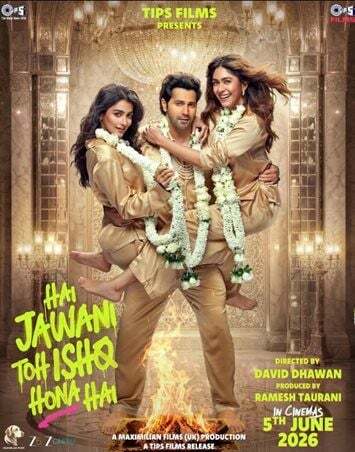
The father-son duo of director David Dhawan and actor Varun Dhawan returns to the silver screen with Hai Jawani Toh Ishq Hona Hai (2026). Touted as the veteran filmmaker’s directorial swan song, this high-budget romantic comedy serves as a nostalgic, chaotic, and unapologetic throwback to the classic 1990s Bollywood commercial cinema. Produced by Ramesh S. Taurani under the Tips Films banner, the film attempts to revive the signature “mindless entertainment” sub-genre through hyper-energetic pacing, mistaken identities, and a glittering London backdrop.
Starring Varun Dhawan, Mrunal Thakur, and Pooja Hegde, Hai Jawani Toh Ishq Hona Hai targets the core demographic of family audiences looking for escapist entertainment. While it successfully matches the kinetic energy of vintage David Dhawan comedies, it struggles under the weight of dated dialogue writing and a heavily recycled plotline.
Technical Overview and Production Details
The production values of Hai Jawani Toh Ishq Hona Hai reflect its premium budget, estimated at over Rs 50 crore. Filmed primarily across upscale locales in London and the United Kingdom, the movie utilizes bright, saturated color palettes courtesy of Director of Photography Ayananka Bose. The musical department relies on an ensemble configuration including Tanishk Bagchi, Javed-Mohsin, and the White Noise Collectives to recreate the auditory aesthetic of late-20th-century Bollywood.
| Attribute | Metadata Details |
| Title | Hai Jawani Toh Ishq Hona Hai |
| Release Date | June 5, 2026 |
| Director | David Dhawan |
| Producer | Ramesh S. Taurani, Gaurav Bose |
| Production House | Tips Films Ltd |
| Lead Cast | Varun Dhawan, Mrunal Thakur, Pooja Hegde |
| Supporting Cast | Maniesh Paul, Jimmy Shergill, Mouni Roy, Chunky Panday, Rakesh Bedi |
| Cinematography | Ayananka Bose |
| Screenplay | Yunus Sajawal |
| Dialogue | Farhad Samji |
| Run Time | 138 Minutes |
Full Plot Synopsis
The narrative center of Hai Jawani Toh Ishq Hona Hai is Jaswinder “Jas” Ahuja (Varun Dhawan), an energetic wedding photographer based in India. Married for five years to Bani (Mrunal Thakur), a career-oriented corporate executive, the couple reaches a severe marital deadlock. Jas harbors an intense desire to start a family and become a father, whereas Bani is fiercely protective of her professional trajectory and insists on strict family planning.
The couple’s irreconcilable differences land them in front of a family court judge following a failed session with a marriage counselor (Kubbra Sait). Adhering to legal protocols, the judge grants them a mandatory six-month cooling-off period before finalizing the divorce decree. Seizing the opportunity to escape the emotional stress, Jas packs his cameras and relocates to London for a high-profile photography assignment.
While navigating the London social circuit, Jas crosses paths with Preet (Pooja Hegde), a wealthy, vibrant young woman living a luxurious life. Preet’s protective older brother is Jogi Randhawa (Jimmy Shergill), a trigger-happy, traditional mansion owner who watches over his sister with extreme vigilance. Despite Jogi’s intimidating aura, romance blossoms rapidly between Jas and Preet, culminating in a commitment to build a future together.
The narrative shifts gears into absolute chaos when Jas receives two simultaneous biological revelations. First, his estranged wife Bani arrives unannounced at his London doorstep, revealing that she discovered she was pregnant shortly after his departure and now wishes to reconcile. Moments later, Preet informs Jas that she, too, is expecting a child.
Trapped in an impossible predicament where he is the father of two concurrent pregnancies by two different women who are entirely unaware of each other’s existence, Jas spirals into a web of frantic deception. Enlisting the help of his eccentric best friend Kannu (Maniesh Paul), Jas orchestrates a dual life within London. He attempts to manage two separate households, dodge the lethal suspicions of Jogi Randhawa, and navigate a series of bizarre medical appointments managed by an eccentric doctor (Chunky Panday) and an incompetent compounder (Rakesh Bedi). The introduction of an opportunistic woman named Rasmalai Rajjo (Mouni Roy), who poses as a fake mother figure to cover up Jas’s tracks, escalates the narrative into a hyperactive, door-slamming situational comedy inside a soundproof London apartment.
Detailed Critique and Artistic Analysis
Direction and Narrative Framework
David Dhawan’s directorial methodology has remained largely unchanged for nearly four decades. In Hai Jawani Toh Ishq Hona Hai, he explicitly revisits the structural blueprints of his previous blockbusters like Saajan Chale Sasural (1996) and Gharwali Baharwali (1998), which were themselves adapted from classic bigamy comedies like the 1984 Hollywood film Micki & Maude.
Dhawan excels at maintaining a brisk, unrelenting narrative pace that prevents the audience from questioning the staggering lack of real-world logic. The universe he constructs is populated by remarkably oblivious characters who accept absurd explanations without hesitation. However, the first half of the film suffers from uneven editing and a lack of narrative momentum. The setup takes too long to establish the core conflict, leaving the audience waiting through an hour of stale jokes before the central comedic engine finally ignites.
Screenplay and Dialogue Architecture
The screenplay by Yunus Sajawal relies heavily on vintage situational tropes: narrow escapes, conveniently timed entries, and elaborate fabrications. While the second-half apartment sequence—where Jas frantically shuffles Bani and Preet between rooms—displays effective comedic geometry, the overarching dialogue design by Farhad Samji undermines the effort. The writing depends on repetitive wordplay, forced rhyming couplets, and dated humor that feels out of touch with contemporary cinematic sensibilities. The film’s handling of marital intimacy is notably awkward, opting for sanitized, dubbed phrases like “making love” to avoid direct terminology, which sits uncomfortably alongside the film’s premise of dual pregnancies.
Performances and Character Dynamics
Varun Dhawan carries the heavy burden of driving the comedy, channeling the high-octane mannerisms of Govinda and early Salman Khan. His physical comedy, facial elasticity, and sheer stamina keep the second half afloat, even when the script fails him. He executes the exhausting physical requirements of an anxious, cornered trickster with total dedication.
"Varun Dhawan acts as the anchor of the chaotic second half, compensating for a weak script through absolute physical commitment and comedic timing."
In contrast, the female leads are largely underutilized. Mrunal Thakur delivers a earnest performance as Bani, trying to ground her character with genuine emotion, but the script completely neglects her career sub-plot after the first fifteen minutes. Pooja Hegde brings glamour and screen presence as Preet, executing her dance numbers with precision, but her character lacks real psychological depth. Ultimately, both women function primarily as decorative plot devices to facilitate Jas’s panic.
The supporting cast provides the film’s most reliable comedic moments:
-
Jimmy Shergill: Delivers a superb deadpan performance as the gun-toting Jogi Randhawa, providing a hilarious counterweight to the surrounding hysteria.
-
Maniesh Paul: Exhibits excellent comedic chemistry with Varun Dhawan, making their frantic scheme-planning scenes highly entertaining.
-
Chunky Panday & Rakesh Bedi: Provide broad, old-school caricature humor during the chaotic hospital sequences.
Visuals, Sound, and Choreography
Ayananka Bose’s cinematography gives the film a polished, bright look, transforming London into a colorful comic-book setting. The production design is grand but logic-defying—portraying a simple wedding photographer living in an ultra-luxurious apartment. The soundtrack features a mix of high-energy dance numbers and romantic ballads choreographed by Remo D’Souza and Bosco Martis. While these musical sequences are visually impressive, they frequently stall the narrative progression.
Strengths and Weaknesses
Strengths
-
Enthusiastic Lead Performance: Varun Dhawan’s boundless energy and commitment to physical comedy salvage the film’s weakest segments.
-
Strong Supporting Cast: Deadpan contributions from Jimmy Shergill and energetic support from Maniesh Paul maximize the comedic value of the script.
-
High Production Value: Sleek cinematography and vibrant UK locations give the movie an appealing, premium cinematic look.
-
Engaging Second Half: The situational comedy peaks in the second hour, successfully delivering classic, laugh-out-loud moments of confusion.
Weaknesses
-
Dated Writing: Farhad Samji’s dialogue relies on forced rhymes and outmoded humor that often falls flat.
-
Slow First Half: The first hour feels flat and lacks the sharp wit needed to keep audiences engaged before the main conflict begins.
-
Weak Characterization for Female Leads: Mrunal Thakur and Pooja Hegde are restricted to thin, formulaic roles with little agency.
-
Recycled Plot: The movie offers no new twists on the familiar “one man, two women” trope, making the final resolution entirely predictable.
Final Verdict
Hai Jawani Toh Ishq Hona Hai functions as a cinematic time capsule. For audiences seeking a nostalgic dose of 1990s-style Bollywood comedy that requires a total suspension of disbelief, David Dhawan’s final film delivers modest entertainment. It is loud, vibrant, and entirely harmless. However, viewers looking for modern wit, sharp writing, or nuanced character development will find it frustratingly dated. Supported by Varun Dhawan’s tireless performance, the film stands as a vibrant, if flawed, farewell to an era of unadulterated commercial filmmaking.