


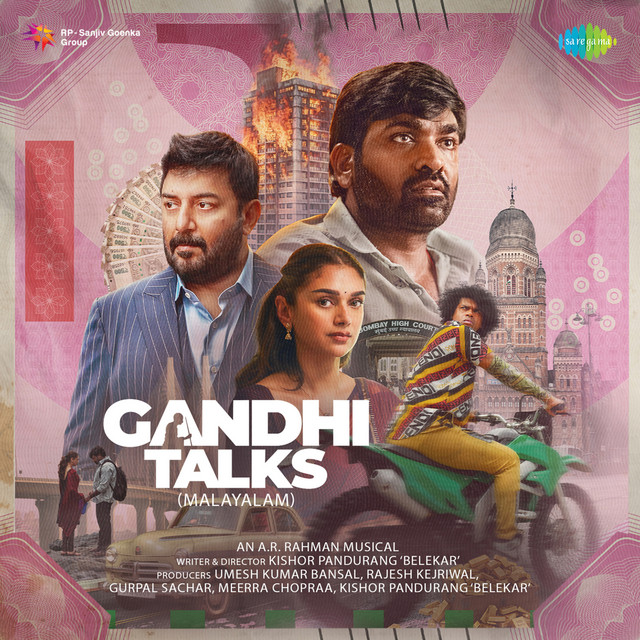
Gandhi Talks Movie Review: A Bold Silent Experiment in Contemporary Indian Cinema
Introduction: A Rare Silent Political Satire
Gandhi Talks is an upcoming Indian silent film directed by Kishor Pandurang Belekar and produced by Zee Studios. Headlined by Vijay Sethupathi, Arvind Swamy, and Aditi Rao Hydari, the film has already generated substantial curiosity for one striking reason: it is conceived as a silent film in the modern era, an ambitious artistic gamble in mainstream Indian cinema.
Blending political satire with social commentary, Gandhi Talks attempts to channel the spirit of Mahatma Gandhi in a world increasingly dominated by noise, media sensationalism, and ideological polarization. With music composed by Academy Award-winning composer A.R. Rahman, the film positions itself as a stylistic departure from conventional Indian storytelling.
Below is a complete review-style breakdown of the film’s premise, artistic execution, performances, thematic depth, and overall cinematic impact.
Film Overview
| Category | Details |
|---|---|
| Title | Gandhi Talks |
| Director | Kishor Pandurang Belekar |
| Producers | Zee Studios |
| Lead Cast | Vijay Sethupathi, Arvind Swamy, Aditi Rao Hydari |
| Music | A.R. Rahman |
| Genre | Political Satire / Drama |
| Language | Silent Film (No Dialogues) |
| Country | India |
| Release Status | Upcoming |
Full Plot Synopsis
Gandhi Talks revolves around an ordinary man navigating a morally fractured and politically charged society. The protagonist, played by Vijay Sethupathi, finds himself caught in a world where truth is distorted, narratives are weaponized, and public discourse is reduced to spectacle.
The film unfolds in a contemporary urban setting marked by political manipulation, media frenzy, and social unrest. Without spoken dialogue, the story relies heavily on visual storytelling, character expressions, situational irony, and background score to convey meaning.
As the narrative progresses, the protagonist’s journey becomes symbolic. He encounters powerful figures—political leaders, media personalities, and citizens driven by fear or ambition—who represent various facets of modern democracy. Arvind Swamy portrays a character aligned with political authority, while Aditi Rao Hydari plays a role that bridges emotional vulnerability and moral clarity.
Through escalating tensions and morally ambiguous circumstances, the central figure gradually embodies Gandhian ideals—not by preaching them verbally, but by living them silently. The film’s structure mirrors a parable, using satire and irony to question whether non-violence, truth, and ethical resistance still have relevance in a hyper-digitized, polarized world.
The climax reportedly shifts from satire to introspection, presenting a meditation on silence itself—whether silence can serve as protest, resilience, or moral confrontation.
Direction and Vision: A High-Risk Creative Gamble
Director Kishor Pandurang Belekar makes an audacious choice by crafting a silent film in an era defined by dialogue-heavy scripts and streaming-era verbosity. This decision transforms Gandhi Talks into more than just a narrative—it becomes a formal experiment.
Visual Language Over Dialogue
Without spoken words, the film depends entirely on:
-
Expressive performances
-
Mise-en-scène
-
Framing and blocking
-
Symbolic imagery
-
A.R. Rahman’s score
This creative choice aligns thematically with Gandhi’s philosophy. Silence becomes metaphorical—suggesting restraint, introspection, and moral clarity amid chaos.
The risk, however, lies in accessibility. Contemporary audiences are accustomed to verbal exposition. Maintaining engagement through purely visual storytelling demands meticulous pacing and disciplined editing.
Performances: Expression as Dialogue
Vijay Sethupathi
Vijay Sethupathi carries the narrative weight. Known for his versatility across Tamil, Hindi, and pan-Indian cinema, Sethupathi relies on facial nuance and body language rather than dialogue delivery.
His performance appears restrained, internalized, and symbolic. Instead of dramatic monologues, his emotional arc unfolds through subtle gestures and reactive silence. This approach aligns with silent-era acting traditions while avoiding theatrical exaggeration.
Arvind Swamy
Arvind Swamy’s presence adds gravitas. His role represents institutional power and ideological complexity. Through posture, gaze, and composure, Swamy conveys authority without a single spoken line.
Aditi Rao Hydari
Aditi Rao Hydari brings emotional softness and poise. Her character grounds the narrative’s moral center. In a silent film, emotional clarity is critical, and Hydari’s expressive subtlety complements the film’s tone.
Themes: Gandhian Ideals in a Noisy Democracy
1. Silence as Resistance
The film’s central metaphor is silence. In an age of constant opinion and digital outrage, silence becomes radical. The protagonist’s refusal to engage verbally acts as quiet protest.
2. Political Satire
Though silent, the film appears sharply satirical. Visual cues likely critique:
-
Media sensationalism
-
Political opportunism
-
Public manipulation
-
Performative nationalism
Without spoken rhetoric, satire must rely on irony in staging and visual contrast.
3. Moral Integrity in Modern Society
At its core, Gandhi Talks asks whether Gandhian principles—truth, non-violence, civil resistance—retain relevance in contemporary India and beyond.
Cinematography and Visual Craft
The success of a silent film depends heavily on its visual grammar. Early promotional material suggests a stylized urban aesthetic with careful attention to framing and composition.
Key elements likely include:
-
Symbolic color palettes
-
Stark contrasts between chaos and stillness
-
Static versus kinetic camera movement
-
Visual metaphors referencing Gandhi’s imagery
Without dialogue, cinematography becomes narrative.
A.R. Rahman’s Score: The Emotional Backbone
Music replaces dialogue in Gandhi Talks, making A.R. Rahman’s contribution central rather than supplementary.
Rahman’s score is expected to function as:
-
Emotional narration
-
Rhythmic pacing device
-
Thematic reinforcement
Given his global acclaim and ability to blend classical Indian instrumentation with contemporary orchestration, the soundtrack could become the film’s defining feature.
Strengths and Weaknesses
Strengths
-
Innovative Silent Format: A bold departure from mainstream Indian filmmaking.
-
Strong Lead Cast: Vijay Sethupathi’s expressive depth anchors the film.
-
Thematic Relevance: Gandhian philosophy contextualized for modern politics.
-
A.R. Rahman’s Score: Elevates emotional storytelling.
-
International Appeal: Silent format broadens accessibility across language barriers.
Weaknesses
-
Limited Commercial Appeal: Silent films can challenge mass audiences.
-
Pacing Risks: Sustaining engagement without dialogue requires precision.
-
Niche Genre: Political satire in silent form may not resonate uniformly.
Cultural and Cinematic Significance
Indian cinema has rarely experimented with silent storytelling in the modern era. By reviving the format, Gandhi Talks positions itself within a lineage that traces back to early 20th-century filmmaking.
However, this is not nostalgia—it is reinterpretation. Instead of recreating silent-era melodrama, the film retools silence as political commentary.
If successful, it could redefine how Indian filmmakers approach experimental storytelling within commercial frameworks.
Final Verdict
Gandhi Talks stands as one of the most intriguing Indian film projects in recent years. Its silent format is not merely a stylistic flourish but a thematic statement. By removing dialogue, the film challenges audiences to observe, interpret, and reflect.
Vijay Sethupathi’s restrained performance, Arvind Swamy’s commanding presence, and Aditi Rao Hydari’s emotional grounding form a strong ensemble foundation. Combined with A.R. Rahman’s musical score, the film has the potential to transcend language barriers.
While its experimental nature may limit mass-market appeal, Gandhi Talks appears poised to become a conversation starter in political cinema and formal innovation.
In an era dominated by noise, Gandhi Talks dares to remain silent—and that silence may speak volumes.