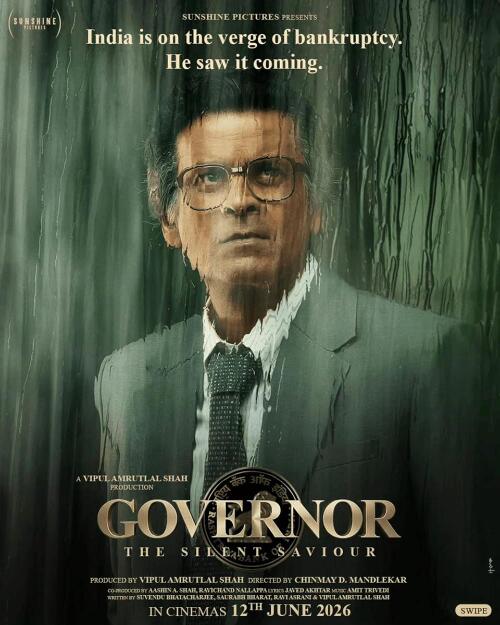
Behind Closed Fiscal Doors: A Deep-Dive Analysis of India’s 1991 Financial Crisis on Screen
The financial thriller has traditionally been a Hollywood stronghold, relying on fast-talking stockbrokers and high-stakes market manipulation. However, director Chinmay D. Mandlekar shifts this paradigm to the bureaucratic corridors of New Delhi and Mumbai in Governor: The Silent Saviour (2026).
Produced by Vipul Amrutlal Shah under Sunshine Pictures, this 122-minute Hindi-language drama aims to transform dry macroeconomic policy into a ticking-clock cinematic event. Released theatrically on June 12, 2026, the film dramatizes India’s harrowing 1991 Balance of Payments crisis. It places a fictionalized version of a quiet bureaucrat at the epicenter of a nation facing total economic collapse.
Critical Film Overview
| Attribute | Details |
| Title | Governor: The Silent Saviour |
| Release Date | June 12, 2026 |
| Director | Chinmay D. Mandlekar |
| Producers | Vipul Amrutlal Shah |
| Screenplay | Suvendu Bhattacharjee, Saurabh Bharat, Ravi Asrani, Vipul Amrutlal Shah |
| Lead Cast | Manoj Bajpayee, Adah Sharma, Noushad Mohamed Kunju, Madhoo, Paritosh Sand |
| Runtime | 122 Minutes |
| Genre | Financial Thriller / Political Drama |
| Language | Hindi |
Full Plot Synopsis: The 1991 Financial Brink
The narrative opens in the tense summer of 1991. The external shocks of the Gulf War have sent global oil prices soaring, drying up foreign remittances and pushing India’s foreign exchange reserves down to a precarious $1.2 billion—barely enough to finance two weeks of essential imports. The country stands on the precipice of a historic sovereign default, a catastrophic scenario that would destroy its international credibility.
Amidst political volatility and a fractured parliament, A. Ramanan (Manoj Bajpayee) is appointed as the Governor of the Reserve Bank of India (RBI). Ramanan is a highly analytical, uncompromising career bureaucrat based heavily on the real-life actions of former RBI Governor S. Venkitaramanan. Unlike typical cinematic heroes who wield weapons, Ramanan’s tools are ledgers, balance sheets, and a profound grasp of global monetary systems.
[1991 India Balance of Payments Crisis]
        │
        ▼
[Foreign Reserves Drop Below $1.2 Billion] ──▶ (Only 2 Weeks of Essential Imports Left)
        │
        ▼
[A. Ramanan Appointed as RBI Governor]
        │
        ▼
[The Radical Solution: Secretly Mortgage 47 Tons of National Gold Reserves]
        │
        ▼
[The Execution: High-Security IMF/Bank of England Emergency Airlift]
Finding the institutional framework between the RBI and the Government of India frozen by indecision and ideological gridlock, Ramanan conceives a radical, highly controversial plan: secretly mortgaging 47 tons of India’s gold reserves to the Bank of England and the Bank of Japan to secure a crucial $400 million emergency loan.
The core of the film follows the tense, classified logistics of transporting physical gold bullion out of secure vaults under heavy security, all while navigating an increasingly inquisitive press corps led by an ambitious investigative journalist, Pallavi (Adah Sharma). Ramanan must fight an uphill battle against systemic leakages, distrusting politicians, and internal institutional resistance to execute the airlift before the midnight deadline of a major international debt repayment.
Detailed Critique: Direction, Script, and Ideological Undertones
Performance Analysis: Bajpayee’s Quiet Steel
Manoj Bajpayee anchors Governor: The Silent Saviour with a performance defined by profound restraint. Stepping away from the explosive dialogue delivery that defines standard political dramas, Bajpayee relies on micro-expressions, deliberate speech patterns, and the physical slump of a man carrying immense institutional weight. His Ramanan is not a bombastic savior but a pragmatic realist trying to transition a country from the remnants of closed-economy restrictions to a modern, integrated marketplace.
Unfortunately, this masterclass in acting occurs largely within a performance vacuum. The supporting cast, including Noushad Mohamed Kunju and Paritosh Sand, are relegated to thin, expository roles that exist merely to state economic metrics or express panic, giving Bajpayee very few complex intellectual stalemates to bounce off of.
Screenplay and Technical Execution
The screenplay—co-written by Suvendu Bhattacharjee, Saurabh Bharat, Ravi Asrani, and Vipul Amrutlal Shah—deserves credit for making dense fiscal policy concepts accessible to a mainstream audience. Terms like foreign exchange reserves, sovereign credit ratings, and structural adjustment loans are neatly embedded into the dialogue without halting the narrative momentum.
Visually, cinematographer Vishal Sinha captures the sterile, shadow-filled offices of New Delhi with a muted, corporate color palette that emphasizes the isolation of the central characters. The mid-point transition of the film, edited by Meghna Manchanda Sen and Sanjay Sharma, effectively shifts the pacing from an analytical boardroom drama into a high-stakes, ticking-clock procedural during the gold airlift sequence.
However, this transition exposes a lack of confidence in the core material. Rather than trusting the natural dramatic tension of macroeconomic negotiations, Mandlekar relies heavily on a booming, hyper-dramatic background score by Mannan Shaah to manufacture artificial anxiety during the logistics scenes.
The Problem of Political Reductionism
The most glaring flaw of Governor: The Silent Saviour lies in its narrative reductionism. By framing a highly collaborative, systemic economic salvation as the legend of a singular “lone ranger,” the script minimizes the monumental contributions of actual political figures, economists, and commerce ministries of the era.
Furthermore, the movie views history through a distinctly modern lens that occasionally feels hostile to democratic processes. The free press, represented by Adah Sharma’s widely caricature-like depiction of an inquisitive reporter, is framed not as an essential pillar of accountability, but as a dangerous liability to state survival. By frequently comparing the state to a suffering, silent mother and political debate to mere “democratic noise,” the film dangerously flirts with populist tropes that privilege centralized, unchecked executive execution over collaborative institutional governance.
Strengths and Weaknesses
Strengths
-
Manoj Bajpayee’s Performance: A masterfully subtle, internal performance that avoids the theatrical traps of traditional biographical cinema.
-
Accessible Financial Exposition: Successfully translates complex, high-stakes 1991 macroeconomic structures into compelling mainstream entertainment.
-
Atmospheric Production Design: The cold, dimly lit administrative rooms accurately capture the analog, high-stress atmosphere of 1990s bureaucracy.
Weaknesses
-
One-Dimensional Supporting Characters: A glaring lack of well-written antagonists or intellectual equals leaves the narrative feeling flat and unchallenging.
-
Melodramatic Directorial Shifts: Escapes procedural realism in the final act to rely on loud background scores and artificial action tropes.
-
Ideological Over-simplification: Flattening a deeply collaborative economic pivot into the triumph of a single individual while portraying press scrutiny as an institutional hindrance.
Final Verdict
Governor: The Silent Saviour is an admirable but flawed entry into India’s growing landscape of institutional thrillers. While it shines brightly when focusing on the quiet steel of Manoj Bajpayee and the procedural mechanics of crisis management, it is ultimately weighed down by a weak supporting script and an overly simplistic view of history. It remains a fascinating watch for audiences interested in financial history, but it falls short of being the definitive cinematic record of India’s economic rebirth.