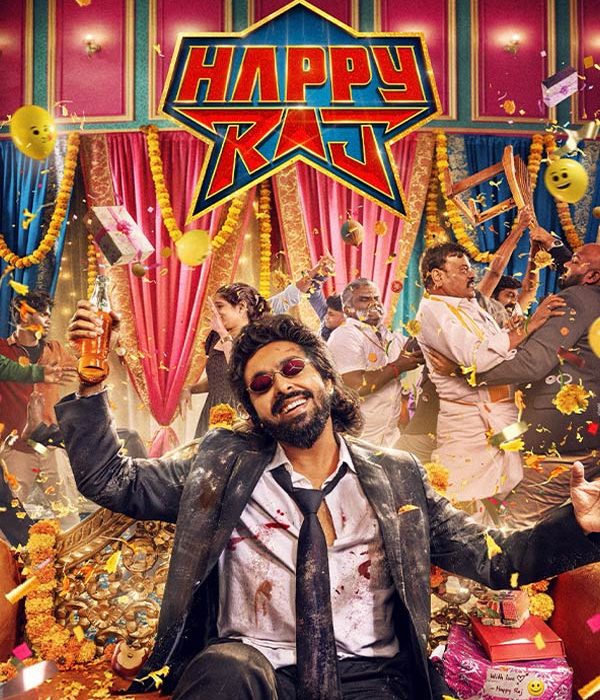
Happy Raj (2026) Movie Review: A Clashing Comedy of Cultures and Comebacks
In the bustling landscape of Tamil cinema, the “lovable loser” trope is a well-worn path, yet it remains a fertile ground for stories that blend middle-class anxieties with slapstick humor. Happy Raj (2026), directed by Maria Raja Elanchezian, attempts to navigate this familiar terrain by injecting a heavy dose of rural-meets-urban conflict and a significant nostalgic hook: the return of 90s “chocolate boy” Abbas to the silver screen.
While the film offers a warm, family-centric core, it occasionally trips over its own comedic excesses. This long-form review dissects the film’s narrative structure, performances, and its technical execution to determine if this GV Prakash Kumar starrer lives up to its “Happy” title.
Movie Overview and Production Data
| Feature | Details |
| Title | Happy Raj |
| Release Date | March 27, 2026 |
| Director | Maria Raja Elanchezian |
| Cast | G.V. Prakash Kumar, Sri Gouri Priya, Abbas, George Maryan |
| Genre | Romantic Comedy / Family Drama |
| Runtime | 158 Minutes (2h 38m) |
| Music | Justin Prabhakaran |
| Cinematography | Madhan Christopher |
| Production | Beyond Pictures (Producer: Jayavardhanan) |
Full Plot Synopsis: From Rural Shadows to Bangalore Chaos
The story introduces us to Anandh Raj, colloquially known as “Happy” (G.V. Prakash Kumar), a young man from a small South Indian village who seems to have a permanent cloud of misfortune over his romantic life. Much of his social standing—or lack thereof—is tied to his father, Kathamuthu (George Maryan), a miserly school teacher nicknamed “Kuthirai Mutta” (Horse Egg) due to his unique facial features.
The film’s prologue painstakingly details how the family’s “unlucky” streak and quirky reputation have made Happy a local laughingstock. Seeking a fresh start and a way to escape his father’s eccentric shadow, Happy moves to Bangalore for an IT job. It is here that the film shifts gears from a rural satire to an urban romance.
Happy meets Kavya (Sri Gouri Priya), a polished, independent colleague. Unlike the women in his village, Kavya sees past Happy’s “loser” persona and appreciates his genuine heart. However, their blossoming romance hits a significant roadblock when Kavya insists that their families must meet and approve of the union.
The conflict arises when Kavya’s father, Rajiv (Abbas)—a sophisticated, high-society NRI—meets the crude, traditionalist, and pathologically frugal Kathamuthu. The second half of the film transforms into a “rural family invasion” of the city. As the two fathers engage in a comical yet pride-fueled cold war (culminating in an absurdly choreographed boxing showdown), Happy and Kavya must find a way to reconcile their vastly different worlds before their families tear their relationship apart.
Detailed Critique and Technical Analysis
Direction and Screenplay
Maria Raja Elanchezian displays a clear affinity for “middle-ground” cinema—films that aim to please both the B-center crowds and the urban multiplex audience. However, the screenplay is a bit of a double-edged sword. The first act suffers from an “explainer video” syndrome, where voiceover narration does the heavy lifting that visual storytelling should have handled.
The pacing improves once the setting shifts to Bangalore, but the narrative often relies on manufactured sentimentality. The script frequently returns to body-shaming humor regarding Kathamuthu’s appearance, which feels dated in 2026 and occasionally mean-spirited rather than lighthearted.
Performances: The Old Guard and the New
George Maryan is undeniably the soul of the film. While G.V. Prakash is the lead, it is Maryan’s performance as the eccentric father that anchors the emotional beats. He manages to make a character who is written as a caricature feel remarkably human by the final act.
G.V. Prakash Kumar stays within his comfort zone as the “lovable loser.” His comic timing is sharp, particularly during the fish-out-of-water sequences in the Bangalore corporate world. Sri Gouri Priya delivers a solid performance as Kavya, providing a grounded contrast to the surrounding chaos.
The most talked-about aspect of the film is the return of Abbas. Making his comeback after a decade-long hiatus, Abbas retains his effortless charm. Though his character, Rajiv, is somewhat underwritten as a “typical NRI dad,” his screen presence adds a layer of nostalgia that will resonate with audiences who grew up on his 90s hits.
Visuals and Sound
Cinematographer Madhan Christopher does an excellent job of distinguishing the two worlds. The village sequences are bathed in warm, earthy tones, while Bangalore is rendered in cool, sleek blues and vibrant neon.
Justin Prabhakaran’s music is “serviceable” but lacks a breakout chartbuster. The track “Thuru Thuru” stands out for its whimsical arrangement, but the background score often telegraphs the emotional moments a bit too loudly, leaving little room for the audience to feel the scene naturally.
Strengths and Weaknesses
Strengths
-
Strong Father-Son Dynamic: The chemistry between G.V. Prakash and George Maryan is the film’s strongest asset, providing a genuine emotional core.
-
The Abbas Factor: The nostalgia of seeing Abbas back on screen is a significant draw for older demographics.
-
Effective Humor: When the film moves away from body-shaming, the situational comedy regarding the “rural invasion” of the city is genuinely funny.
Weaknesses
-
Predictable Writing: The plot follows the “culture clash” blueprint to the letter, offering few surprises.
-
Dated Gags: The reliance on jokes about physical appearances feels out of touch with modern sensibilities.
-
Over-reliance on Narration: The film’s opening is bogged down by excessive exposition.
Final Verdict
Happy Raj is a “warm enough” entertainer that succeeds in spite of its flaws. It is a film that thrives on the goodwill of its ensemble cast rather than the strength of its original writing. For fans of G.V. Prakash and those seeking a nostalgic glimpse of Abbas, it offers a pleasant, if slightly overlong, theatrical experience. It is a safe, feel-good family drama that reminds us that while you can take the man out of the village, you can’t take the village—or his eccentric father—out of the man.
Final Score: 3.0/5 Stars